Grade Selection
EN8 (080M40) is an unalloyed medium carbon steel — approximately 0.40% carbon, no significant alloy additions. EN19 (708M40 / 42CrMo4) is a chromium-molybdenum alloy steel with 0.90–1.20% chromium and 0.15–0.40% molybdenum in addition to carbon.
The practical difference is hardenability and the strength achievable after heat treatment. EN8 through-hardens reliably in sections up to about 40mm; EN19 through-hardens in sections up to approximately 65mm. In the quenched and tempered condition, EN8 achieves around 550–700 N/mm² tensile strength; EN19 achieves 900–1100 N/mm².
Choose EN8 for general engineering shafts, keys, bolts and machined parts where mild steel is too weak but you do not need high tensile strength. Choose EN19 when you need higher tensile strength, need to through-harden a larger section, or are replacing an alloy steel component. EN8 data sheet • EN19 data sheet
EN8 (BS 970: 080M40, European: C40E) is a medium carbon engineering steel — the most widely used engineering steel grade in the UK. It contains 0.36–0.44% carbon with no deliberate alloy additions. It is significantly stronger than mild steel and can be surface hardened by flame or induction to 50–55 HRC.
EN8 is used for: general engineering shafts and axles, spindles, mandrels, keys, studs and stressed pins, gears (light to medium duty), agricultural machinery driveline components, bolts and high tensile fasteners, and flame or induction hardened surface wear components.
It is available as bright drawn round bar (6–150mm), black round bar (16–250mm), hexagon, square and flat bar. Normalised condition typical tensile: 550–700 N/mm². Full EN8 data sheet ›
EN19 (BS 970: 708M40, European: 42CrMo4, AISI: 4140) is a chromium-molybdenum alloy engineering steel. It is the most widely used alloy steel in UK engineering — specified whenever EN8 strength is insufficient or when section sizes exceed EN8's hardenability limit.
EN19 is used for: high-tensile shafts and axles, gears and pinions (medium to high duty), spindles, crankshafts, high-tensile bolts and studs, oil and gas valve bodies and downhole components, automotive driveline and transmission components, and hydraulic pump shafts.
In the quenched and tempered (T) condition: tensile strength 900–1100 N/mm² (section-dependent). Available bright drawn 6–150mm, black 20–300mm, and pre-treated (T condition) in selected sizes. Full EN19 data sheet ›
Free-cutting steel is steel with elevated sulphur content — typically 0.25–0.35% — which forms manganese sulphide (MnS) inclusions throughout the microstructure. These inclusions act as chip breakers during machining, producing short, manageable chips rather than long stringy ones, reducing friction at the tool face and allowing higher cutting speeds and longer tool life.
The primary free-cutting grade is EN1A (230M07 / 11SMn30). The leaded version, EN1A Pb (230M07Pb), adds lead for an additional 25–35% improvement in cutting speed. EN8M (212A42) combines EN8-level carbon with elevated sulphur for applications needing both improved machinability and some tensile strength.
Use free-cutting steel when: you are producing high volumes on automatic lathes, cycle time is critical, surface finish is important, and the component is not subject to significant impact loading, welding, or high fatigue. Do not use free-cutting steel for components subject to shock loads, welded assemblies, or applications where transverse ductility is important. EN1A data sheet ›
Through hardening means the entire cross-section of the bar achieves full hardness after quenching. Plain carbon steels like EN8 through-harden reliably only in small sections; alloy steels like EN19 and EN24 through-harden in larger sections. The entire component — surface and core — is hard and strong after heat treatment.
Case hardening (carburising) involves heating the steel in a carbon-rich atmosphere (880–930°C) so that carbon diffuses into the surface to a depth of typically 0.5–2.0mm. When quenched, the carbon-enriched surface becomes very hard (58–64 HRC) while the low-carbon core remains tough and ductile. This gives the ideal combination for gear teeth — hard surface to resist wear, tough core to resist fracture under impact.
Case hardening grades include EN36 (655M13), 8620 (805M20) and EN32M (210M15). Full case hardening guide ›
Nitriding is a surface hardening process carried out at low temperature (480–530°C) in a nitrogen-rich atmosphere. Nitrogen diffuses into the steel surface forming very hard nitrides — achieving surface hardness of 700–850 HV (approximately 65–70 HRC equivalent) without quenching. Because there is no quench, dimensional change is minimal (typically <0.01mm change in diameter), which is critical for precision components.
EN40B (722M24 / 31CrMo12) is the standard nitriding grade. Its high chromium content (2.8–3.3%) forms chromium nitrides during the process, producing a dense, wear and corrosion resistant compound layer — superior to hard chrome in many hydraulic rod applications and without the environmental concerns of hexavalent chromium.
EN40B must be supplied in the Q+T condition before nitriding — the core properties are established at this stage. Parkside Steel stocks EN40B bright bar in Q+T condition, ready for precision grinding and nitriding. EN40B data sheet ›
Shaft grade selection depends on the loading, required strength and section size:
Light duty, lightly stressed: EN3B (070M20) or EN8 (080M40). EN3B for weldable shafts; EN8 where higher strength is needed.
General engineering shafts <40mm: EN8 (080M40), normalised or hardened and tempered.
General engineering shafts >40mm, or higher tensile required: EN19 (42CrMo4). Through-hardens to 65mm reliably.
Large section shafts (>65mm) or high toughness required: EN24 (817M40 / 34CrNiMo6 / 4340). The nickel addition enables through-hardening in much larger sections.
Precision shafts needing a very hard, corrosion-resistant surface without distortion: EN40B (31CrMo12), gas nitrided.
If in doubt, call our sales team with the diameter, length, and required tensile strength — we can recommend the right grade in a few minutes. 01623 687 660
Grade Equivalents
The UK equivalent of 42CrMo4 is EN19, with the BS 970 number 708M40. The AISI/SAE equivalent is 4140. The Japanese equivalent is SCM440. All four designations refer to the same chromium-molybdenum alloy steel: approximately 0.40% C, 1.0% Cr, 0.20% Mo.
42CrMo4 is the DIN/EN designation used on European engineering drawings. When a drawing specifies 42CrMo4 and you are buying from a UK stockholder, ask for EN19 or 708M40 — the material is identical. Mill certificates can be dual-certified to both standards. EN19 / 42CrMo4 data sheet ›
AISI 4140 is the American designation for the chromium-molybdenum alloy steel known in the UK as EN19 / 708M40 and in Europe as 42CrMo4 / 1.7225. The compositions are closely matched — both contain approximately 0.40% C, 0.90–1.20% Cr and 0.15–0.30% Mo.
If a drawing or purchase order specifies AISI 4140, ordering EN19 (708M40) from a UK stockholder gives you the correct material. Where dual certification is required (the mill cert must reference both AISI 4140 and the BS or EN grade), request this when ordering — it is available from most mills. Full grade equivalents table ›
AISI 4340 is equivalent to EN24 / 817M40 in BS 970 and 34CrNiMo6 / 1.6582 in the European standard. The Japanese equivalent is SNCM439. All are nickel-chromium-molybdenum alloy steels: approximately 0.40% C, 1.40% Cr, 1.50% Ni, 0.25% Mo.
EN24 in the quenched and tempered condition is designated EN24 (817M40) — the most common supply form for bright bar. If a drawing specifies 4340, order EN24 from a UK stockholder. EN24 data sheet ›
SAE 8620 is equivalent to 805M20 in BS 970 and 20NiCrMo2-2 / 1.6523 in the European standard. The Japanese equivalent is SNCM220. All are nickel-chromium-molybdenum case hardening steels: approximately 0.20% C, 0.50% Cr, 0.55% Ni, 0.20% Mo.
SAE 8620 is the most widely used automotive case hardening steel worldwide and is specified by name on many gearbox gear drawings. Parkside Steel stocks 805M20 which can be dual certified to SAE 8620. 8620 / 805M20 data sheet ›
100Cr6 (DIN 1.3505) is the European designation for high-carbon chromium bearing steel — the most common grade for ball and roller bearings worldwide. The AISI equivalent is 52100 and the Japanese equivalent is SUJ2.
All designations refer to the same steel: 0.95–1.10% C and 1.35–1.65% Cr. After oil hardening and tempering at 150°C it achieves 60–64 HRC. Supplied in the spheroidise-annealed condition for machining.
The "EN" designation system comes from the original BS 970 standard which was progressively revised and ultimately withdrawn from current status — superseded by European standards. However, EN numbers persist in industry for several reasons: tens of thousands of legacy engineering drawings reference them; many producers still manufacture to the old BS numbers or dual-certify; tooling and fixture setups are labelled with them; and stock lists across the industry use them as shorthand.
Where EN numbers appear on modern drawings, they almost always correspond to a current BS EN grade — EN8 is now C40E, EN19 is 42CrMo4, EN24 is 34CrNiMo6, and so on. Parkside Steel maintains both naming conventions on all stock and data sheets. Grade equivalents table ›
Bright Bar vs Black Bar
Bright bar is produced by cold drawing hot rolled bar through a die. This produces a smooth, clean surface finish and precise dimensional tolerances — typically h9, h10 or h11 per BS EN 10278. Bright bar goes directly onto most CNC lathes without preliminary turning. It is stronger than the equivalent hot rolled bar due to work hardening from the drawing process.
Black bar (hot rolled bar) is rolled at high temperature and left with the characteristic dark mill scale surface finish. It is dimensionally less precise than bright bar (tolerances to BS EN 10060) but significantly more economical for larger diameters where the bright drawing process becomes impractical. Black bar is the standard supply form for diameters above approximately 100mm.
For most turned component applications, specify bright bar. For large-diameter billets to be machined from solid, or for structural applications where the surface does not matter, black bar is the economical choice. Full stock range ›
Bright bar is used for any application where the bar goes directly into a machining operation — typically a CNC lathe or turning centre — and where a precise starting diameter and smooth surface reduces or eliminates preliminary turning operations.
Common uses include: turned shafts and spindles, CNC turned components, hexagon bar for nuts, bolts and fittings (hex bar can be loaded directly into a lathe collet or hex chuck at the nominal AF dimension), square bar for keys and gibs, flat bar for wear strips and slideways. View bright bar stock range ›
Centreless ground bar is bright drawn bar that has been additionally processed by centreless grinding — passing it through a grinding wheel and regulating wheel to achieve even tighter diameter tolerances and a superior surface finish (Ra 0.4–0.8 μm or better) compared to the as-drawn condition.
It is specified when the drawing requires tighter than h9 tolerance on diameter, when surface finish is critical for sealing or fit purposes, or when the bar must be used as a bearing surface without additional grinding. Common applications include precision shaft journals, hydraulic piston rods and bearing locations. Available on request for selected grades and sizes — call to discuss.
Tolerances
h9 is an ISO tolerance designation for bright bar per BS EN 10278. The "h" indicates that the upper deviation is zero — the bar can only be at or undersize, never oversize. The "9" indicates the tolerance grade (how tight the range is).
For a 25mm nominal diameter bar to h9: upper deviation = 0.000mm, lower deviation = approximately −0.052mm. So the bar can range from 24.948mm to 25.000mm. This tight tolerance means the bar fits directly into collets, chucks and fixtures designed for 25mm without preliminary turning.
Smaller diameters use h9 (tightest); larger diameters step to h10 and then h11 as the tolerance widens with diameter. Full h9/h10/h11 tolerance tables ›
All three are "h" tolerances — meaning the upper deviation is zero (bar is never oversize). The number indicates how wide the tolerance band is: h9 is the tightest, h11 is the widest. For a given diameter, h11 allows a larger undersize deviation than h9.
Per BS EN 10278, smaller diameters (typically up to 50mm) are supplied to h9. Medium diameters (50–80mm) to h10. Larger diameters (80mm+) to h11. The tolerance widens with diameter because maintaining tight tolerances on larger drawn sections is increasingly difficult and costly.
In practice, this means that for a 100mm bright bar, the tolerance is wider than for a 20mm bar — both are "bright bar" but the 100mm bar has a wider permissible undersize deviation. Full tolerance table by diameter ›
Our standard cut-to-length tolerance is −0 / +2mm. This means the cut piece will never be shorter than your specified length and may be up to 2mm longer. This is the industry standard tolerance for bandsaw cut bar and is achievable across all profiles and grades.
If tighter length tolerances are required, this is available by arrangement — please discuss when ordering. For very precise face quality, our saws produce a clean, square cut face suitable for most engineering applications without further facing.
Heat Treatment
The T suffix in BS 970 grade designations indicates the steel has been supplied in the Quenched and Tempered condition. The bar has already been hardened (oil quenched from the austenitising temperature) and tempered to achieve specified mechanical properties — before it leaves the mill or stockholder.
EN24 means 817M40 supplied Q+T, with a typical tensile strength of 850–1150 N/mm² depending on section size. EN19T means 708M40 in the Q+T condition, typically 900–1100 N/mm². The material can be machined directly to drawing without further heat treatment. This is convenient where the customer does not have heat treatment capability or where distortion from hardening must be avoided.
Important: pre-treated bar should not be re-hardened unless a new Q+T cycle is carried out correctly — elevated machining temperatures do not significantly affect the properties, but local overheating from grinding or flame cutting can locally soften the material. Tempering guide ›
Both processes involve heating steel above its transformation temperature and then cooling it — but the cooling rate differs and so do the results.
Annealing: heat to austenitising temperature, then cool very slowly (typically in the furnace, switched off). Produces the softest possible condition — maximum ductility and machinability, minimum hardness. Used when maximum softness for machining is required. Spheroidise annealing (used for high-carbon bearing steels) is a specific variant that produces the optimum machining condition.
Normalising: heat to austenitising temperature, then cool in still air. Faster cooling than annealing, giving a finer grain structure and slightly higher strength and hardness than annealed material. Used to homogenise the microstructure after forging, relieve stresses, and produce a uniform, predictable condition before final machining or heat treatment. Most bright bar is supplied in the normalised or as-drawn condition. Normalising guide ›
Flame and induction hardening require a carbon content of at least 0.35% to achieve useful surface hardness. The process rapidly heats the surface above the transformation temperature and then quenches — hardening only the surface while the core remains largely unchanged.
Suitable grades: EN8 (080M40) — achieves 50–55 HRC surface; EN8D, EN9 — similar response; EN19 (42CrMo4) — 52–58 HRC; EN24 — can be locally induction hardened after pre-treatment.
Not suitable: free-cutting grades (EN1A, EN8M), mild steel (EN3B), case hardening grades (designed for carburising not direct hardening), and EN40B (which is designed specifically for nitriding). Hardening guide ›
Certification & Traceability
An EN 10204 3.1 certificate is a material test certificate issued by the manufacturer's authorised inspector. It contains the chemical composition and mechanical test results for the specific batch supplied — verified by an inspector independent of the manufacturing department. The certificate references the heat number, linking it to the specific melt of steel.
Specify 3.1 when: your quality system requires certified approved supplier documentation; your drawing or purchase order specifies it; the component is for oil and gas, aerospace, defence or pressure equipment application; or you need material traceability for audit purposes. Most alloy grade steel specifications for these sectors require 3.1 as a minimum.
Parkside Steel can supply 3.1 certs on all alloy grades. Request when ordering — the certificate is included with the delivery or supplied electronically. Certification guide ›
Both are EN 10204 material test certificate types, but the verification level differs:
2.2 (Test Report): issued by the manufacturer, confirming the product meets the order requirements with test results based on non-specific inspection — results may be from similar products, not the specific batch supplied. Adequate for general engineering applications where batch-specific traceability is not required.
3.1 (Inspection Certificate): issued by the manufacturer's authorised inspector — a representative independent of the production department. Test results relate to the specific products supplied and are verified independently. Provides heat-number-specific traceability. Required for oil and gas, aerospace, defence, pressure vessel and most specification-driven procurement.
If your drawing or quality system specifies "3.1 cert", do not accept a 2.2 — they are not equivalent. Full cert types guide ›
Yes. Parkside Steel (Stockholders) Ltd holds BSI ISO 9001 certification, certificate number FS 86692. Our quality management system covers purchasing, stockholding, sawing and processing, material traceability and dispatch. The system is independently audited by BSI on a regular surveillance schedule.
ISO 9001 certification means our processes are documented, followed and independently verified — not self-declared. For supplier approval purposes, certificate copies are available on request. Accreditations page ›
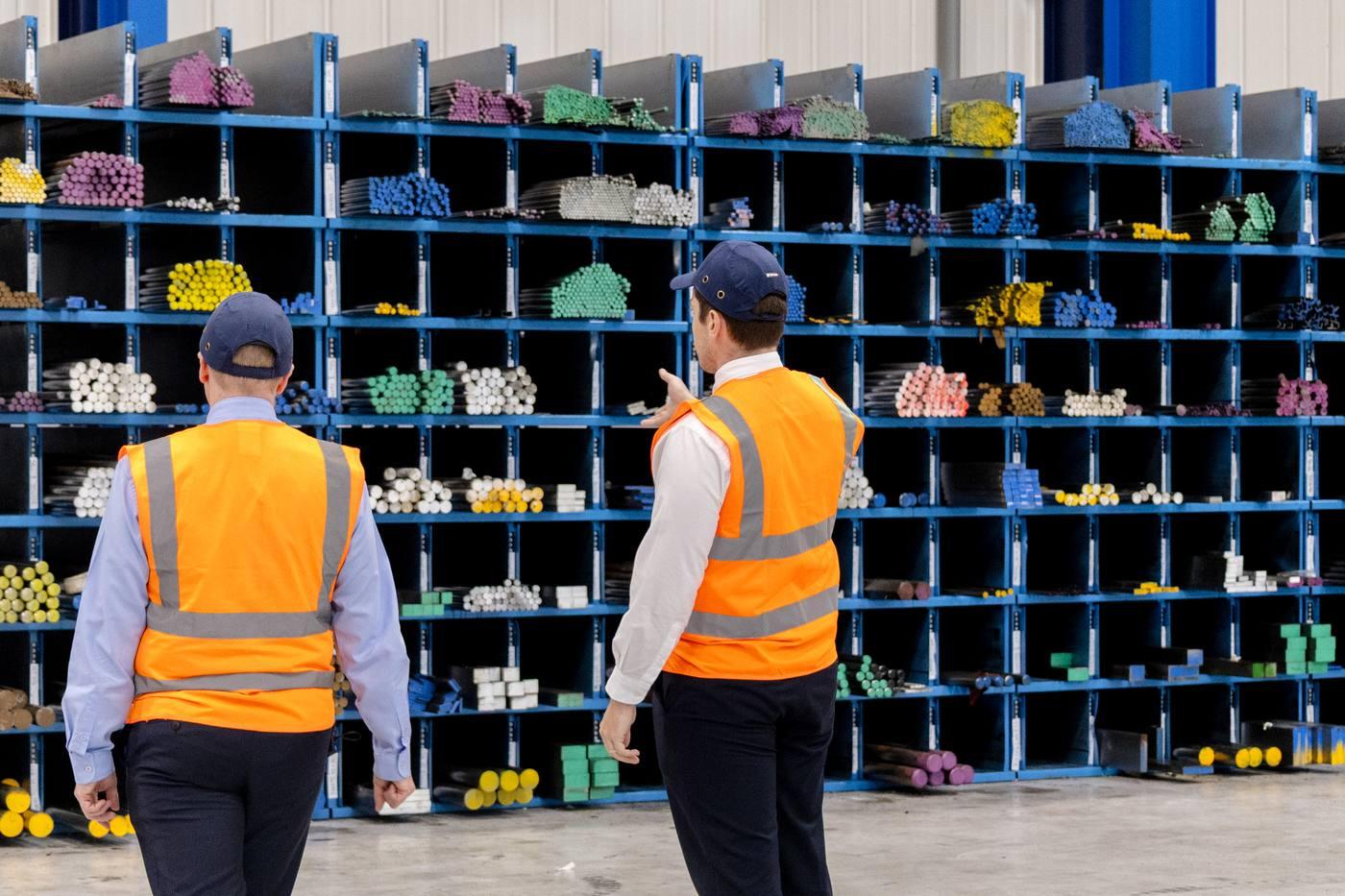
Engineering steel bar is marked on the bar end with a colour code to indicate the grade. Colour coding is not a national standard — it varies between stockholders, so a code that means one grade here may mean another elsewhere. These are the codes Parkside uses on its own stock:
Green — EN1A (230M07)
Yellow — EN8 (080M40), EN8D (080A42)
White — EN16 (605M36)
Blue — BMS (080A15)
Blue / orange — EN31 (535A99)
Brown — EN24 (817M40)
Magenta — EN1A Pb (230M07Pb)
Orange — Grey cast iron (EN-GJL-250)
Blue / red — EN3B (070M20)
Blue / white — EN36C (832M13)
Blue / yellow — EN9 (070M55), EN-GJS-500C ductile iron
Black / white — S355 J2
Black / yellow — EN32M (210M15)
Green / black — 8620 (805M20)
Green / blue — EN26 (826M40)
Green / magenta — EN30B (835M30)
Green / yellow — EN8M (212A42)
Magenta / blue — EN39B (835M15)
Magenta / white — EN40B (722M24)
Red / white — EN36 / EN36B (655M13)
Red / yellow — EN-GJS-400C ductile iron
White / yellow — EN-GJS-600C ductile iron
Yellow / white — EN19 (708M40), EN19 (709M40)
A few codes are shared where the two materials are unmistakable in the rack — blue / yellow covers EN9 and EN-GJS-500C, and yellow / white covers EN19 while white / yellow covers EN-GJS-600C. Colour coding is a useful guide but should always be confirmed against the delivery note or mill certificate — not relied upon as the sole means of grade identification. Grade identification guide ›
Ordering & Delivery
One piece. There is no minimum order quantity, no minimum order value, and no small order surcharge. A single piece of 25mm EN8 at 300mm long gets the same service as a full load of EN19.
We believe every order matters — this is a core operating principle at Parkside Steel, not a marketing line. If a machine shop or maintenance engineer needs one piece urgently, we cut it and get it moving. Request a quote ›
The fastest way is to call us directly on 01623 687 660 Monday to Friday, 08:00–17:00. Tell us the grade, profile (round, hex, square, flat), diameter or size, quantity, and lengths required. We confirm stock availability and give you a price and delivery date on the same call.
You can also email sales@parksidesteel.uk.com or use our online quote form. We respond to email enquiries within 2 working hours. For urgent requirements, calling is always fastest.
Yes. Same-day collection is available at our Sherwood Park site (Byron House, 4 Willow Drive, Sherwood Park, Annesley, NG15 0DP), Monday to Friday 08:00–17:00. Call ahead to confirm your grade and size is in stock and allow approximately 1–2 hours for cutting. We will have the material ready when you arrive.
Our site is five minutes from Junction 27 of the M1. Customers are welcome to arrive and wait in our reception while the order is processed.
It depends on whether your order needs cutting or is a full bar:
Cut-to-length orders: 2–3 working days from order confirmation to despatch, across the full range. This covers scheduling on our 13 saws and preparing the cut pieces for delivery.
Full-bar (no cutting): typically next working day via our own fleet (East Midlands, Yorkshire, North West, West Midlands, East Anglia, Bedfordshire) or specialist carrier to all other UK mainland areas.
Same-day collection: available at our Sherwood Park site — call ahead to confirm stock.
For urgent requirements, always call — we will tell you honestly what we can do and how quickly.
We deliver to the whole of the UK mainland. Our own flatbed fleet runs 4–5 times per week to: the East Midlands (home base), Yorkshire, the North West (Manchester, Stoke, Warrington, Leeds), the West Midlands (Birmingham, Coventry, Wolverhampton), East Anglia, and Bedfordshire/Northamptonshire.
For all other areas — Scotland, Wales, the North East, the South West, London and the South East — we use specialist steel carrier partners who deliver next day on the vast majority of stocked lines. Delivery areas & fleet ›
Cutting & Sawing
We operate 13 saws on site at our Sherwood Park facility:
12 band saws — COSEN and RONTGEN bj-alfa band saws covering the full range from small-diameter bright bar up to 600mm diameter black round bar. Band saws produce a clean, square cut face with minimal kerf loss.
1 TSUNE high-speed circular saw — for bulk orders of longer pieces where cutting speed is critical. A new outfeed table added in 2024 improved throughput on longer-length bulk orders.
13 saws means we can run multiple jobs simultaneously with no queue — particularly important for urgent requirements or when volume spikes arrive at the same time. Cutting service details ›
Our RONTGEN bj-alfa band saws can cut up to 600mm diameter — one of the widest single-site cutting capacities available from a UK engineering steel stockholder. We stock black round bar to 600mm in selected grades. For very large diameters, call ahead to confirm the specific grade and diameter combination is in stock and can be cut on the required date.
There is no formal minimum cut length, but practical limitations apply at very short lengths — very short pieces (less than approximately 20–25mm) can be difficult to hold safely on a band saw and may not produce a satisfactory cut quality. For very short pieces, call to discuss — we can often accommodate requirements that appear awkward.
There is no minimum on quantity: one piece cut to any reasonable length is our standard service.
Weldability
EN8 (080M40) can be welded but requires care and correct procedure. The 0.40% carbon content means there is a risk of hydrogen-induced cold cracking (HAC) if the material is welded without preheat and allowed to cool too quickly.
Recommended procedure for EN8: preheat to 150–250°C before welding; maintain interpass temperature; use low-hydrogen electrodes (E7018 equivalent for MMA); slow-cool after welding — wrap or place in vermiculite; post-weld stress relief at 600–650°C for stressed joints.
For light-duty, low-stress welded joints on EN8, preheat may not always be practical — accept the slightly increased risk for non-critical applications. For structural or safety-critical joints, follow the full procedure or consider using EN3B (mild steel) as an alternative where the lower strength is acceptable. EN8 data sheet ›
EN19 (42CrMo4) is weldable with correct procedure but requires more care than EN8 due to its alloy content. The carbon equivalent (CE) is higher, increasing hardenability of the heat-affected zone and the risk of cold cracking.
Required procedure: preheat to 200–300°C; use low-hydrogen electrodes; maintain interpass temperature; post-weld heat treatment (stress relief at 600–650°C) is strongly recommended for all stressed joints. Do not attempt to weld EN19T (pre-treated Q+T material) without specialist procedure — the HAZ will lose its heat-treated properties and may crack. EN19 data sheet ›
No — welding free-cutting steel should be avoided. The elevated sulphur content (0.25–0.35% in EN1A) that makes it excellent for machining causes significant problems when welded. Sulphur forms low-melting-point iron sulphide compounds at grain boundaries which cause hot cracking during solidification of the weld pool.
If a component genuinely needs to be both machinable and weldable, use EN3B (070M20 mild steel) — it machines acceptably and welds well. If the component is an automated-turned part that also has a welded sub-assembly, consider splitting the design so the turned part does not need welding. EN1A data sheet ›
Identifying Steel Grades
Several methods can be used, in order of reliability:
1. Bar end colour code — the most immediate indicator for bright bar in stock: green = EN1A; yellow = EN8/EN8D; white = EN16; brown = EN24; yellow/white = EN19; blue/yellow = EN9; red/white = EN36; green/black = 8620; magenta/white = EN40B. Always verify against the delivery note or cert.
2. Mill certificate / delivery note — if the original documentation accompanies the bar, this is definitive.
3. Spark test — grinding the bar against a grinder and observing the spark pattern gives a rough indication of carbon content. High-carbon steel (EN9) gives bright, bushy sparks; low-carbon steel gives longer, less branched sparks. Alloy additions affect the pattern. A skilled operator can make reasonable grade estimates from spark testing, but it is not precise.
4. PMI (Positive Material Identification) — portable XRF or OES analysers give near-instant chemical composition and can identify alloy grades positively. Most professional testing labs offer this service. For critical applications where the grade must be confirmed with certainty, this is the definitive method.
Mild steel is a subset of carbon steel — specifically low carbon steel containing typically 0.15–0.25% carbon. EN3B (070M20) and S275 are examples. Mild steel is easily weldable, ductile and formable, but has relatively low strength and cannot be significantly hardened.
Carbon steel is a broader term covering steels whose properties are determined primarily by their carbon content rather than alloy additions. It includes mild steel, medium carbon steel (EN8, 0.40% C) and high carbon steel (EN9, 0.55% C). Higher carbon content gives greater strength and hardenability but reduces weldability and ductility.
Alloy steel (EN19, EN24, EN36 etc.) adds deliberate alloy elements beyond carbon — chromium, molybdenum, nickel — to achieve properties not achievable with carbon alone, particularly hardenability in large sections.
A/F stands for Across Flats — the measurement taken across opposite flat faces of the hexagon bar. This is the size used when ordering and specifying hex bar, and corresponds directly to the spanner size that will fit the bar.
A 25mm A/F hexagon bar will accept a 25mm spanner or collet directly without any turning required. This is why hex bar is specified for bolt and nut production — the flat faces are already formed and the A/F dimension matches the tooling directly. Do not confuse A/F with the across-corners dimension, which is larger. Hexagon bar stock range ›