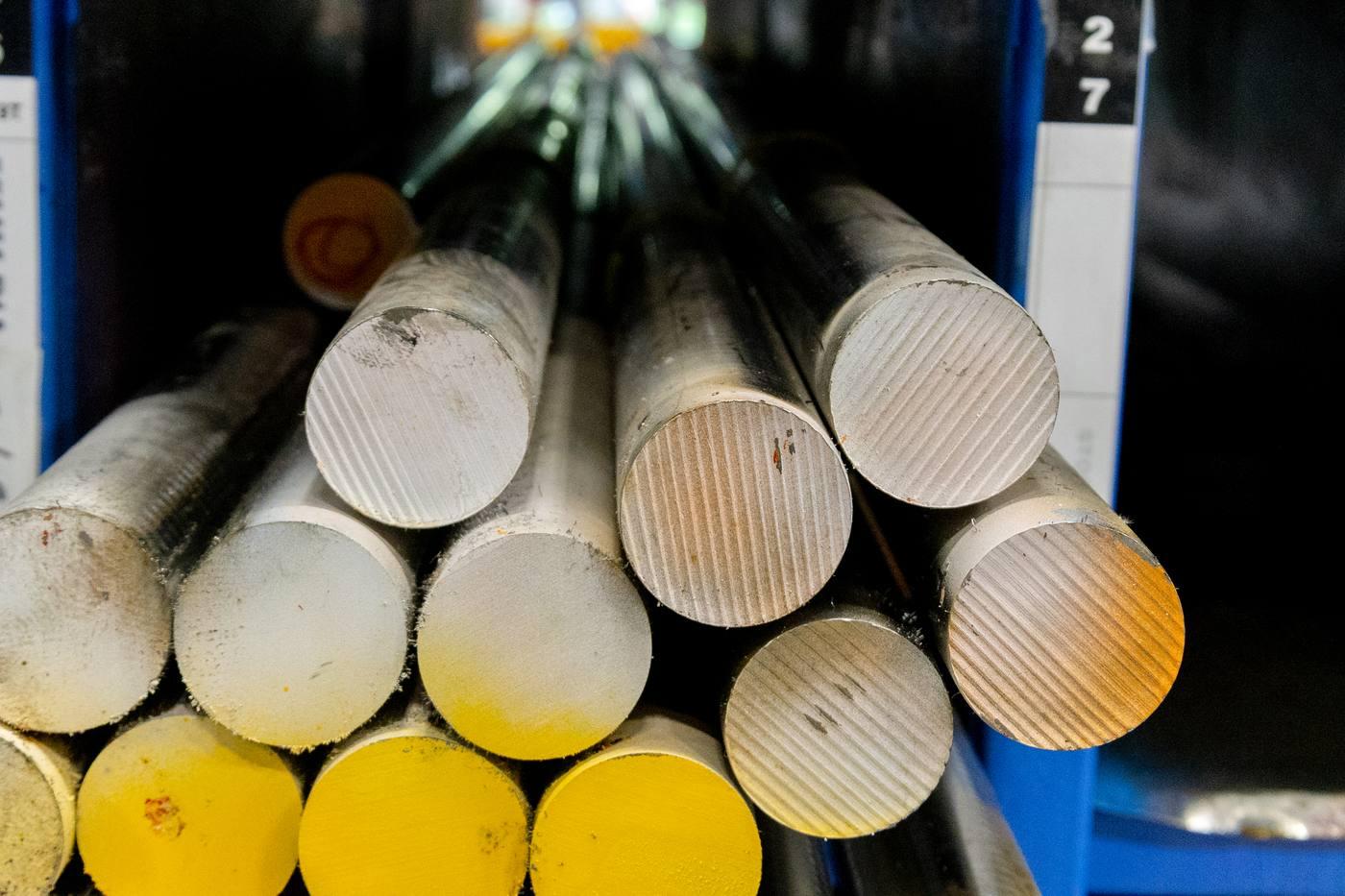
Grade Designations.
| BS EN 10083-2:2006 | C40E / 1.1186 |
| BS 970:1991 (withdrawn) | 080M40 |
| AISI/SAE | 1040 / 1045 |
| DIN | C40 / 1.0511 |
| JIS | S40C |
Availability & Supply Condition.
Bright Rounds: 6–150mm | Black Rounds: 25–600mm | Squares: 16–100mm (bright) | Hexagons: 6–75mm AF (bright)
Supply condition: Bright Drawn, Bright Turned, or Hot Rolled Black. Normalised or as-drawn.
Cut to length from 1 piece — −0/+2mm standard tolerance — 2–3 day turnaround — Cutting service details ›
Chemical Analysis.
Values shown as percentages by weight (% wt). Values are ranges unless stated as maxima.
| Designation | C | Si | Mn | P max | S max |
|---|---|---|---|---|---|
| 080M40 | 0.36–0.44 | 0.10–0.40 | 0.60–1.00 | 0.05 | 0.05 |
| C40E | 0.37–0.44 | 0.17–0.37 | 0.50–0.80 | 0.035 | 0.035 |
For full chemical analysis with heat number, request an EN 10204 3.1 material test certificate when ordering — available on all alloy grades. Certificate types explained ›
Mechanical Properties.
Values shown for standard supply condition. Properties vary by section size and heat treatment condition.
| Condition | Size (mm) | Tensile Rm (N/mm²) | Yield Re (N/mm²) | A% min | HB approx |
|---|---|---|---|---|---|
| Normalised | ≤16 / >16–40 / >40–100 | 550–700 / 530–680 / 490–640 | ~340 / ~310 / ~275 | 14 / 14 / 15 | 163–207 |
| H&T (induction) | All | ≥700 | ≥480 | ≥14 | — |
Hardness values: see our hardness conversion table to convert between HRC, HB, HV and tensile strength.
Typical Applications.
- General engineering shafts and axles
- Spindles, mandrels and arbors
- Keys, studs and stressed pins
- Gears (light to medium duty)
- Flame and induction hardened components
- Agricultural machinery parts
Key Benefits.
- Significantly stronger than mild steel
- Good machinability in normalised or annealed condition
- Suitable for flame and induction surface hardening
- Can be heat treated — normalised, annealed, hardened & tempered
- Widely available from stock — comprehensive size range
- Cost-effective alternative to alloy steels for many applications
Remarks & Guidance.
Preheat to 150–250°C before welding and slow-cool afterwards to avoid hydrogen cracking. Post-weld heat treatment recommended for stressed joints. For applications requiring deep section hardening or higher toughness, consider EN19 (708M40) or EN24 (817M40). Flame and induction hardening achieves 50–55 HRC surface hardness on correctly conditioned material.
Relevant Heat Treatment Processes.
This grade responds to the following heat treatment processes. Click any card for temperatures, cooling methods and expected hardness values.
Normalising refines grain structure and relieves stress after forging or machining.
Annealing softens this grade for machining by heating and slow cooling.
This grade responds to quench hardening — oil or water quench from austenitising temperature.
Temper after hardening to achieve the required tensile range and reduce brittleness.