What the Rule Actually Says
Lead has a specific, useful job in free-cutting steel: at the small quantities used it stays as fine, soft, insoluble particles that lubricate the cut, break the chip and let a bar run fast and clean on an automatic lathe. It is also a restricted substance, and the permission to keep using it in machining steel is granted by an exemption that has to be renewed periodically rather than a right that stands forever.
On 21 November 2025 the European Commission published a set of delegated directives revising the lead exemptions under the RoHS 2 Directive (the EU's restriction on hazardous substances in electrical and electronic equipment). The entry that matters to anyone buying free-cutting bar is exemption 6(a)(I) — lead as an alloying element in steel for machining purposes. It survived, the cap stayed at 0.35% lead by weight, but it was renewed only until 30 June 2027. The sister entries went the same way: 6(a)(II) for batch hot-dip galvanised steel keeps a 0.2% cap to the same date, and 6(c) for leaded copper alloys (free-machining brass, up to 4% lead) runs to the same 30 June 2027. If an exemption lapses rather than being renewed again, the material does not get a new, tighter ceiling of its own — it simply falls back under the standard RoHS limit of 0.1% lead by weight in any homogeneous material, which is the general restriction the exemptions exist to lift.
EU member states have to transpose the revised directives into national law by 30 June 2026, with the provisions taking effect from 1 July 2026. The important detail sits in what happens after June 2027: the exemption is not automatically renewed again. To carry on, industry has to either substitute the lead out or demonstrate — with evidence — that substitution is still not scientifically or technically practicable. In other words, the burden of proof has shifted onto continued use.
Why There Is Lead in EN1A Pb at All
Free-cutting steel is engineered to be cut, not to carry load. The British workhorse is EN1A (230M07), a low-carbon steel with a deliberately high sulphur content that forms manganese sulphide inclusions — the inclusions act as internal chip-breakers, which is why EN1A machines so much more freely than a plain mild steel. EN1A Pb (230M07 Pb) takes the same base and adds a small lead addition, typically in the 0.15–0.35% range, on top of the sulphur. The result is the easiest-machining bar most shops ever load: faster surface speeds, cleaner threads and bores, longer tool life and reliably short chips on multi-spindle and sliding-head work.
That is the whole point, and it is also the problem. The lead that does the work is the lead the regulation is about. For a deeper look at what each element does in the bar — sulphur, lead, manganese and the rest — our note on the chemical elements in steel sets out the roles. Notice too that the 0.35% exemption cap lands almost exactly on the top of EN1A Pb's normal lead band: the rule is written around this grade, not a generous margin above it.
Who This Actually Applies To
This is where it pays to be precise, because the rule is narrower than the headlines suggest. RoHS governs lead in electrical and electronic equipment (EEE). The trigger is not "did I machine leaded steel" but "did a leaded-steel part end up inside an electrical or electronic product placed on the EU market." A leaded-steel pin in a connector, a turned contact, a fastener or shaft inside an appliance, a machined component in a piece of electronic equipment — those are in scope. A hydraulic fitting, a general-engineering shaft or an agricultural component that never goes into EEE is a different question.
Two more things sharpen it for a UK shop:
- These are EU rules. Great Britain runs its own UK RoHS regime, which has tracked the EU exemptions closely to date. The practical trigger for most British machinists is the export route: if your finished parts, or your customer's finished assemblies, are placed on the EU or EEA market, EU RoHS timing is the one that bites — regardless of where the turning was done.
- There is a slower, broader track behind it. Separately from RoHS, metallic lead has been proposed for addition to the REACH authorisation list, which over a longer horizon would tighten the use of lead across alloys generally rather than only in EEE. That process is still under discussion and is not a 2027 deadline — but it is the direction of travel, and it is why "the exemption was renewed, so nothing to do" is the wrong read.
The Alternatives, and What They Cost You
There is no single drop-in replacement that keeps every property of leaded free-cutting steel, which is exactly why the exemption keeps being renewed. But the options are real and shops are already using them:
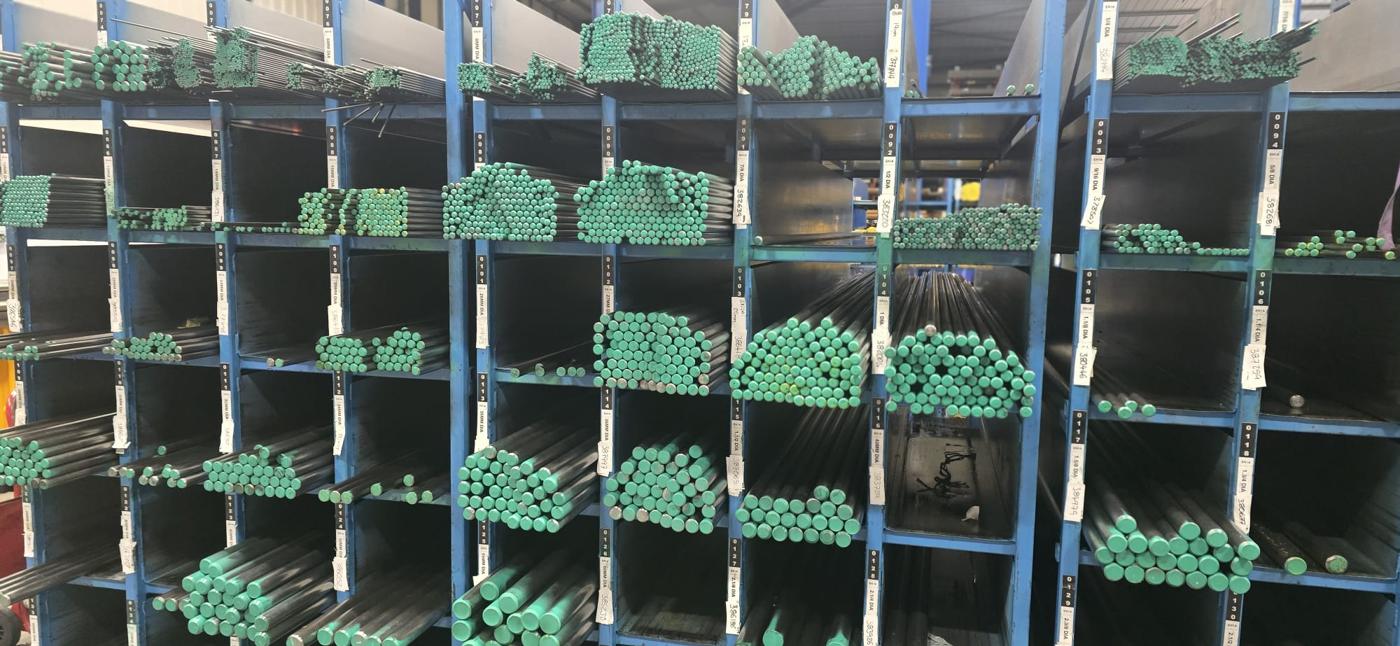
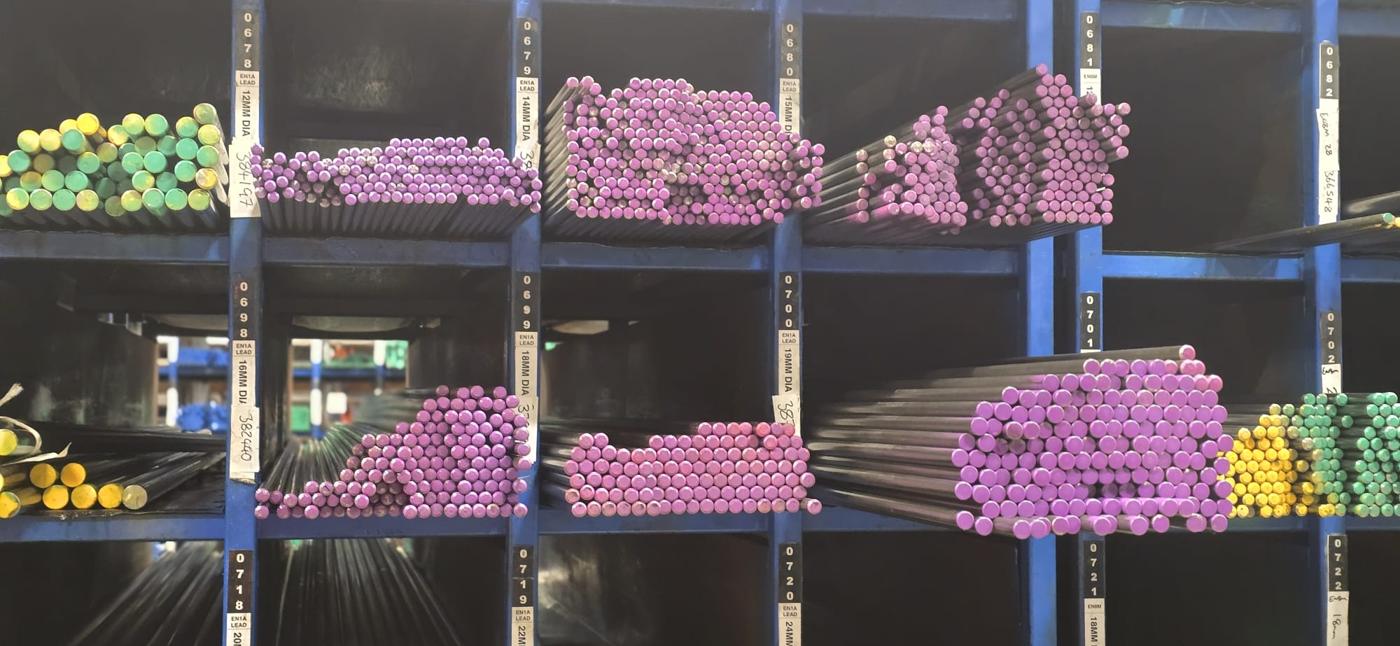
Standard EN1A (230M07) in the same racking, ends colour-coded green against the pink of the leaded grade above. Both are stocked side by side, so a trial bar is a pick rather than a mill order.
| Route | What it is | Trade-off to plan for |
|---|---|---|
| Non-leaded EN1A | Standard sulphur free-cutting EN1A (230M07) with no lead addition | Still machines well on the sulphur inclusions; expect slightly shorter tool life and more attention to chip control than EN1A Pb |
| Higher-sulphur / resulphurised | Free-cutting grades that lift sulphur (and manganese) to recover some of the chip-breaking the lead gave | Chip-breaking improves; higher sulphur can reduce transverse ductility, so check it suits the part |
| Bismuth / tin free-cutting | Specialist grades that substitute bismuth or tin for lead as the machining aid | Closest machining behaviour to leaded, but a specialist order, not a stock staple — longer lead times and price |
| Process change | Re-cut speeds, feeds and tooling around a non-leaded bar rather than swapping chemistry alone | No material change, but cycle-time and tool-cost work on the shop floor; best done as a trial, not a switch |
The sensible move for most shops is not to wait for a deadline and then scramble, but to trial a non-leaded bar on a representative part now, while the leaded option is still available to fall back on. That way the cycle-time and tool-life numbers are real data from your own machines rather than a supplier's claim, and any process change is made calmly instead of against a June 2027 clock.
Want to trial non-leaded EN1A against your usual leaded bar? Tell us the grade, diameter and quantity and we will cut you a comparison length from stock.
► Request a QuoteWhat It Means If You Buy From Stock
Parkside stocks both sides of this choice as bright bar: EN1A Pb for the shops that still want the easiest-machining leaded bar while the exemption runs, and standard non-leaded EN1A (230M07) for anyone who wants to start de-risking now. Because both sit on the same racks, a shop can run a side-by-side trial without changing supplier, buy only the length it needs to prove the part, and keep the leaded option in reserve until the data says otherwise.
The practical detail that makes a substitution manageable is the same boring one that matters in every material change: traceability. Every consignment ships with EN 10204 certification under our ISO 9001 system, so the grade and cast behind a trial are documented from the start — which is what you need when a customer asks you to evidence that a part is within, or free of, a restricted substance. And because we cut to length from stock across 13 saws from 10mm to 600mm diameter with no minimum order, trialling an alternative costs a cut length, not a mill quantity.
What to Do Before It Becomes Urgent
- Flag which part numbers use leaded bar and end up in EEE. That intersection — leaded steel and electrical/electronic end use on the EU market — is your real 2027 exposure. Everything else has more time.
- Ask your customers where their assemblies are placed on the market. If a component ships into an EU-market electronic product, the EU timing applies to it even if you never touch the EU directly.
- Trial a non-leaded grade on a representative part now. Capture cycle time, tool life and surface finish on your own machines while the leaded fallback still exists.
- Keep the certification. Whatever you machine, keep the EN 10204 cert that proves the grade and cast — substance declarations are far easier to produce from a paper trail you already hold.
- Don't over-switch. Parts that never go near EEE are not on a 2027 clock. Change what the rule actually touches, and leave the rest until the broader REACH picture is clearer.
If you supply into automotive, defence, oil and gas or hydraulics, the first job is usually working out which programmes have an electrical or electronic end use at all — a drivetrain shaft and a sensor housing live under different rules even when they are turned from the same bar. If you are weighing one grade against another while you are at it, our grade equivalents table is the quickest way to line up the designations.
Our View
The renewal in November 2025 was good news dressed as a reprieve. Free-cutting steel keeps its lead for now, the cap is unchanged, and nobody has to re-engineer a product this quarter. But the exemption now carries an expiry date and a substitution test, and behind it sits a slower REACH process pointing the same way. Read together, they are a clear signal: the long-term direction is away from lead, even if the short-term rule still permits it.
That is an argument for planning, not panic. The shops that will find this easiest are the ones that treat the next eighteen months as trial time — proving a non-leaded bar on real parts, keeping the certs, and changing only the lines the rule actually touches — rather than the ones that discover in mid-2027 that a product they sell into the EU depends on a material they can no longer specify. If you want to run that comparison, or you just want to know which of the two bars to hold for which job, call us and we will talk it through.
Speak to the Parkside Team
Our sales team is on the phone Mon-Fri 08:00-17:00. No minimum order. Next-day available on most lines.