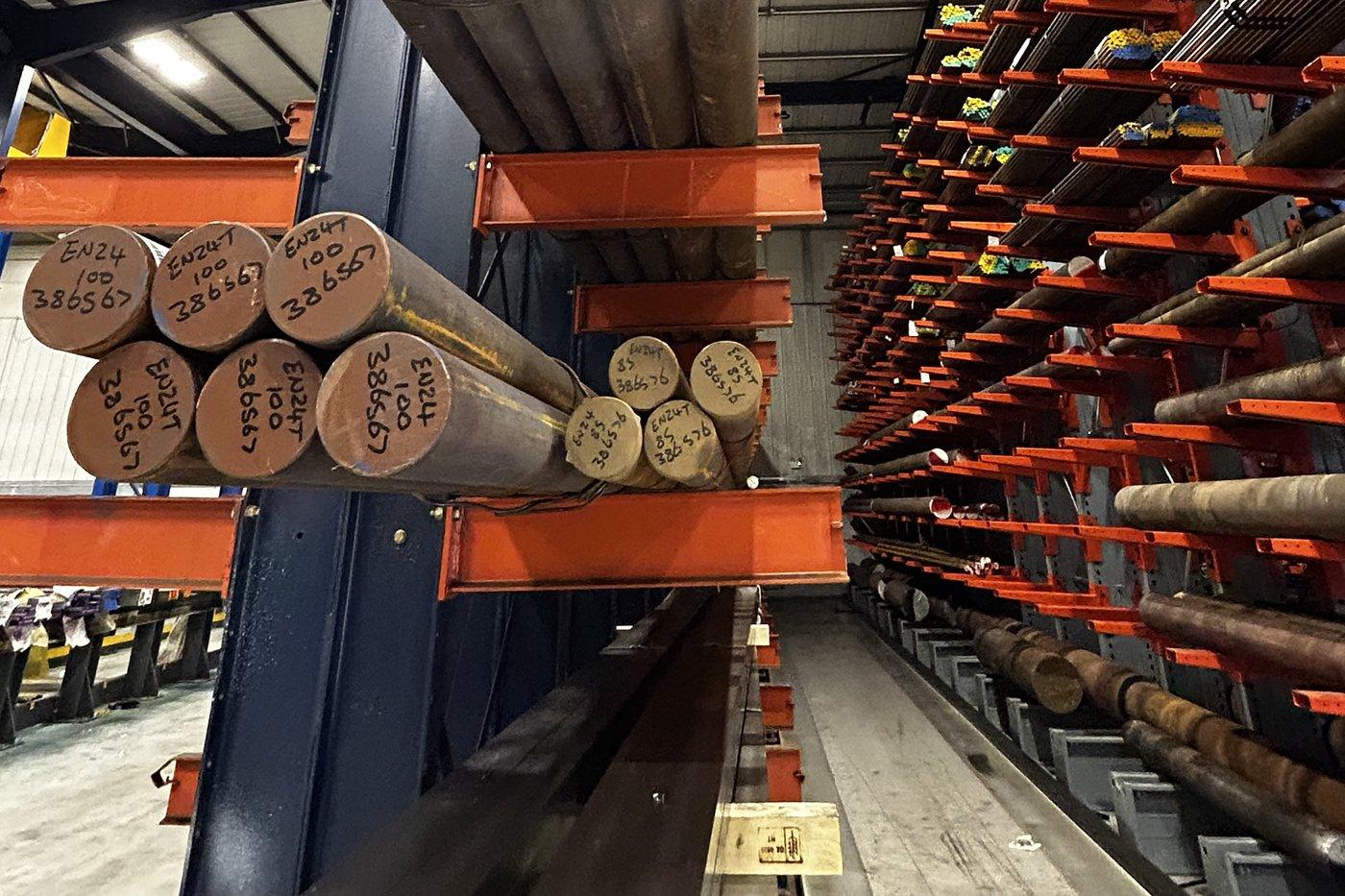
Grade Designations.
| BS EN 10083-3:2006 | 34CrNiMo6 / 1.6582 (also 40CrNiMo6 / 1.6565) |
| BS 970:1991 (withdrawn) | 817M40 |
| AISI/SAE | 4340 (nearest analogue — looser spec than 817M40) |
| DIN | 34CrNiMo6 / 1.6582 |
| JIS | SNCM439 |
Grade-equivalence naming varies by supplier and is conventional rather than an exact chemistry match — confirm against your EN 10204 certificate where precise cross-referencing matters.
Availability & Supply Condition.
T-condition bright rounds: 8–100mm | Black rounds: 25–500mm
Supply condition: EN24 is typically supplied in the T condition — quenched and tempered, designated 817M40T — as bright drawn or hot rolled black. It can also be supplied as rolled or annealed where the bar is to be machined heavily or heat treated after machining. Specify the condition on the order.
Cut to length from 1 piece — −0/+2mm standard tolerance — 2–3 day turnaround — Cutting service details ›
T Condition, As Rolled or Annealed.
EN24 is a through-hardening grade, so the condition it arrives in decides both what you can do with it at the machine and what properties the finished part has. Three are available.
Quenched and tempered at the mill and designated 817M40T. The bar arrives at its working strength, so there is no heat treatment to schedule and no distortion to design around — you machine it and the part is finished. This is what most drawings call for and what we normally supply, in both bright drawn and hot rolled black.
Also available. As-rolled bar is in the state it left the hot mill; annealed bar has been reheated and slow-cooled to soften it and even out the structure. Either is the right choice when the part needs heavy machining before it is hardened, or when you intend to harden and temper it yourself to a specific condition after machining.
Specify the condition on the order — it is not implied by the grade name. Asking for “EN24” without a condition usually gets you T, but a part that will be hardened after machining wants as-rolled or annealed instead, and a bar already in T condition will not machine as freely. The condition is recorded on the EN 10204 certificate, so it can be checked on arrival. More on our material certification ›
Chemical Analysis.
Values shown as percentages by weight (% wt). Values are ranges unless stated as maxima.
| Designation | C | Si | Mn | P max | S max | Cr | Ni | Mo |
|---|---|---|---|---|---|---|---|---|
| 817M40 | 0.36–0.44 | 0.10–0.35 | 0.45–0.70 | 0.04 | 0.04 | 1.00–1.40 | 1.30–1.70 | 0.20–0.35 |
| 34CrNiMo6 | 0.30–0.38 | 0.17–0.37 | 0.50–0.80 | 0.035 | 0.035 | 1.30–1.70 | 1.30–1.70 | 0.20–0.30 |
For full chemical analysis with heat number, request an EN 10204 3.1 material test certificate when ordering — available on all alloy grades. Certificate types explained ›
Each alloying element does a specific job: nickel gives toughness, particularly at low temperature, so the steel resists brittle failure under shock loading; chromium adds depth of hardenability, carrying the hardening effect into the core rather than just the surface; molybdenum resists the temper brittleness that can otherwise develop when tempering thick sections.
Mechanical Properties.
Values shown for standard supply condition. Properties vary by section size and heat treatment condition.
| Condition | Size (mm) | Tensile Rm (N/mm²) | Yield Re (N/mm²) | A% min | HB approx |
|---|---|---|---|---|---|
| H&T (T) | ≤16 / >16–40 / >40–63 / >63–100 | 1150 / 1000 / 900 / 800 | ≥900 / ≥800 / ≥700 / ≥600 | 10 / 10 / 11 / 11 | 300–341 |
| Normalised | All | ~860 | ~600 | ~14 | ~248 |
Normalised-condition properties are shown for reference only — this is not a stocked condition; see Availability above. Hardness values: see our hardness conversion table to convert between HRC, HB, HV and tensile strength.
Typical Applications.
- Heavy-duty shafts, axles and spindles
- High-performance gears and pinions
- Automotive and drivetrain components — connecting rods, drive shafts, axle shafts
- Aerospace and defence structural components
- Oil and gas downhole and pressure components
- Large forgings and ring-rolled sections
- High-tensile bolting — aerospace grade
- Hydraulic cylinder rods and pistons
Key Benefits.
- Higher strength and toughness than EN19 in large sections
- Good deep hardenability due to nickel content
- 817M40T supplied pre-treated — no further heat treatment required
- Excellent fatigue strength for dynamic loading
- Recognised globally as AISI 4340 / 34CrNiMo6
- Comprehensive size range from stock
Remarks & Guidance.
Welding requires carefully controlled procedures. Preheat to 250–350°C and carry out post-weld heat treatment. For 817M40T (pre-treated bar), the heat treatment has already been applied — bar should not be re-hardened in service. For less demanding applications where cost is important, consider EN19 (708M40). Where a component needs extreme surface wear resistance alongside a tough core, 817M40 can also be nitrided or direct surface hardened — discuss with your heat treater alongside the core specification.
Relevant Heat Treatment Processes.
This grade responds to the following heat treatment processes. Click any card for temperatures, cooling methods and expected hardness values.