Company announcements, industry news, LinkedIn posts and steel market updates from the Parkside Steel team. What we are investing in, what is moving in the market, and what it means for your business.
We post updates on investment,
new routes & product news
A hydraulic rod has to carry load, stay straight under thrust and present a hard, corrosion-resistant surface — and no single property covers all three. We compare the common base grades (EN8, EN19 and EN24), explain what induction hardening and hard chrome plating actually add, and show why a rod is sized for buckling first and chosen for grade second.
Read more ►The UK Carbon Border Adjustment Mechanism starts on 1 January 2027 with no transitional reporting phase. Confirmed scope and commodity codes, the £50,000 threshold, quarterly returns with the first due 31 May 2027, how the rate is actually calculated — and where liability sits if you buy from a UK stockholder rather than importing yourself.
In November 2025 the EU renewed the RoHS exemption for lead in free-cutting steel — but only to 30 June 2027, with a substitution test attached. For shops turning EN1A Pb by the tonne that is a date, not a ban. We set out what the rule actually says, which parts it applies to, the non-leaded alternatives, and how to trial a switch without losing cycle time.
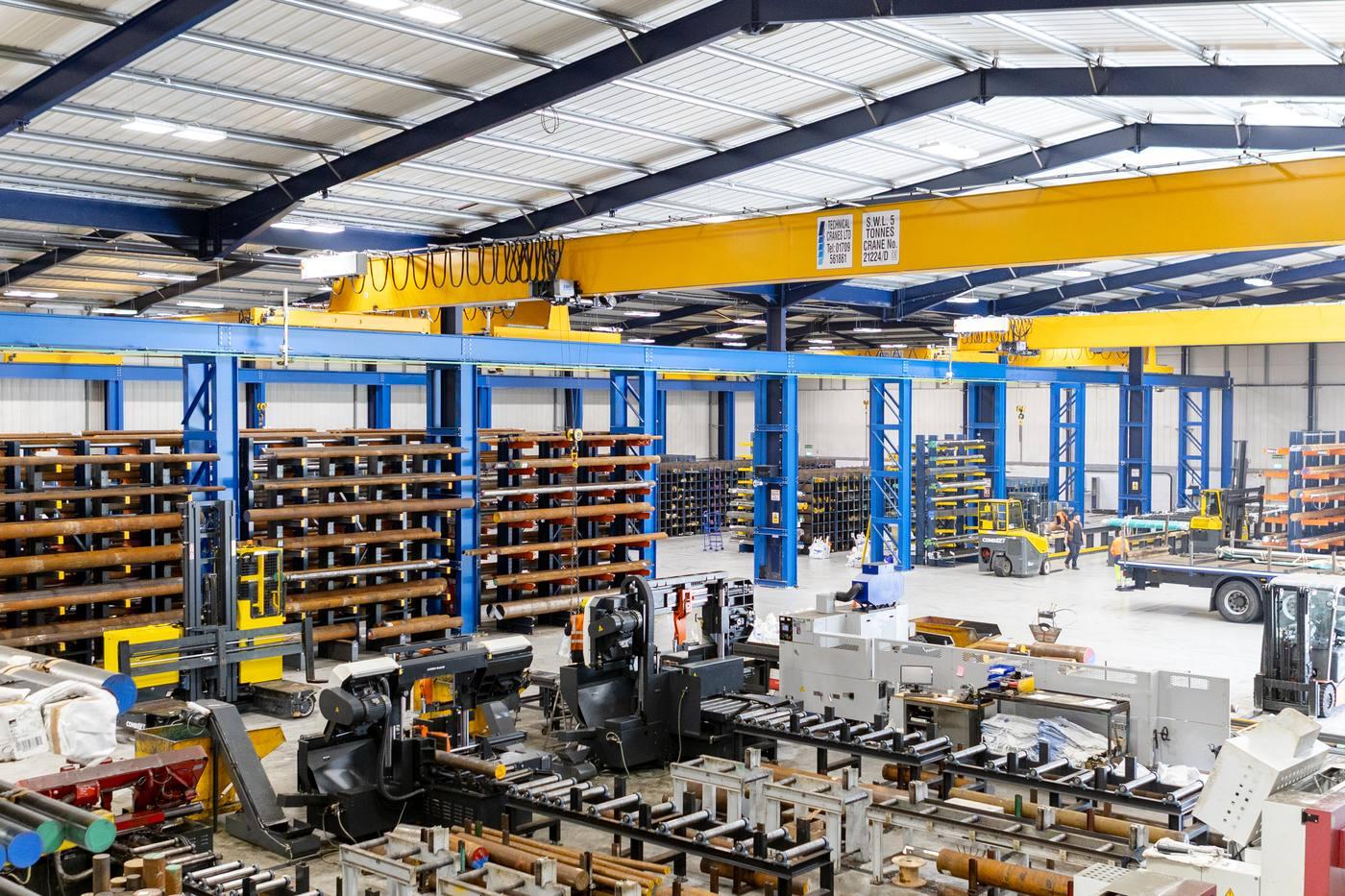
New external cantilever racking on the yard holds a further 1,000 tonnes of material, with room for more bays on the same run. It does not add new profiles — it adds depth to the ranges we already hold, concentrated on EN39B, EN30B and annealed EN24. More black bar on the ground in the UK, at the point where import quota rather than demand is what limits supply.
Two things happen at the end of September: the exemption protecting contracts signed before 14 March 2026 expires, and quarter two of the UK steel quota opens. Quarter one showed how fast a line can close — the non-alloy merchant bar residual quota was exhausted on day 27 of 92. We set out what changes, which quota category each product form sits in, and why bright bar buyers are inside the measure for the first time.
Hardness and hardenability are not the same thing, and the difference shows up in the purchase order. We explain the Jominy end-quench test to BS EN ISO 642, how a distance along the test bar stands in for the core of a much larger one, and why SAE 8620, EN36 and EN36C give very different core hardness from 50mm up to 300mm diameter.
From 1 October 2026 the EU requires importers to declare the country where steel was melted and poured, backed by a mill certificate showing the origin and heat number. It hard-wires traceability into the supply chain — and reaches every UK fabricator and machinist who exports steel or steel parts. We explain what the rule says, what evidence now counts, and why the heat number on your mill certificate matters more than ever.
EN24T (817M40T) tensile strength is not one number — it changes across four section-size bands, and reading the wrong one throws the design maths off. We explain what the property tables actually say, where the grade gets specified, and why cutting exactly what a job needs from stock beats buying a mill's minimum run.
A steel mill certificate is the proof that what you received is what you paid for — but specify the wrong type and you either pay for testing you did not need or cannot prove the bar met spec. We explain the four EN 10204 types, what a 3.1 shows field by field, how to read one without a metallurgy degree, and why documentation is under more scrutiny in 2026.
The Government’s £298bn Defence Investment Plan and firming July order books both point to rising demand for machined engineering components — and the alloy bar they are cut from. We explain where that demand lands, the grades defence and precision work run on, and why it collides with the tighter July safeguard quotas on a steel market that is 90% import-reliant.
The UK–India trade deal took effect on 15 July 2026, and steel was one of its hardest-fought chapters. India is already one of the UK’s largest sources of bar and rod. We explain what the steel carve-out does, why it is a different supply chain to the coated flat steel making headlines, how it sits alongside the July safeguard quotas, and why CBAM still applies from 2027.
On 16 July 2026 British Steel passed into public ownership — but the rail and construction steel it makes at Scunthorpe is a different supply chain to bright and alloy engineering bar. We explain what the nationalisation does and does not change, why engineering bar stays ~90% imported, and how the July quota regime is the change that really touches your price and lead time.
The UK is switching from blast furnaces to electric arc furnaces — the Port Talbot EAF has slipped and British Steel is now publicly owned. We explain what EAF steel means for alloy bar quality, residual elements like copper and tin, and why the EN 10204 mill certificate matters more than ever.
From January 2027 the UK Carbon Border Adjustment Mechanism adds a carbon charge to imported iron and steel. We explain who is liable, the £50,000 threshold, how the charge is calculated, and which grades and sources are most exposed.
After a demanding site move at the start of 2025, we enter 2026 fully settled at our Sherwood Park facility — with more saws, more vehicles, more grades and sizes, and lead times and output at their best ever levels. Here is where things stand and what we are working on next.
Parkside Steel has acquired a new 60,000 sq ft unit at Sherwood Park — allowing us to increase our range of products and processes across two sites. A significant step forward in our capacity to serve customers.
New Renault vehicles arrived this morning, increasing our fleet capacity. A dedicated weekly run now covers Stoke, Manchester, Leeds and surrounding areas — making Parkside Steel a realistic choice for North West engineering businesses.
A new outfeed table fitted to our TSUNE high-speed circular saw means we can now offer reduced lead times on bulk orders for longer pieces. If you are being quoted lead times that don’t suit your schedule, call us.
“At Parkside Steel, we believe every order matters — no matter the size. Whether you need one piece of 25mm bright bar or a full load of 300mm black round, you get the same response, the same care, and the same service. That is just how we work.”
From July 2026, the UK’s steel safeguard measures increase to 50% on excess imports with quota volumes cut by 60%. We look at which grades are most affected and what buyers should consider when planning stock requirements this year.
“We’ve been quiet on LinkedIn. The team have been hard at work making sure we get our customers what they need when they need it. We enter 2026 fully settled at our new site and lead times & output have never been better.”
Carbon, manganese, chromium, molybdenum, sulphur — every element on an EN 10204 cert tells you something about how the steel will behave. Our new guide explains each one in plain English, with typical ranges for common engineering grades.
“After a challenging site move at the beginning of the year we are now settled and ready to enter 2026 better than ever. We’d like to thank all our customers and suppliers for their support throughout 2025. The business is in the strongest position it has ever been.”
Our sales team is on the phone Mon–Fri 08:00–17:00. No minimum order. Next day available on most lines.