What a Rod Has to Survive
Before choosing a grade it helps to be clear about what fails on a hydraulic cylinder rod, because the failures are not all the same kind of problem and they do not all point to the same steel.
- Tensile and fatigue load. On the extend stroke the rod is in tension; on retract it is in compression. Over millions of cycles the governing property is the steel's fatigue strength, which tracks its tensile strength and its freedom from surface defects.
- Buckling. A long rod under thrust is a column. If it is too slender for the load it will bow and fail long before the steel reaches its yield point. This is a stiffness-and-geometry problem first and a strength problem second.
- Side load and bending. Misalignment, a trunnion mount, or a cylinder working off-axis puts a bending moment into the rod. That raises the local stress at the rod surface and at the thread or eye.
- Wear and corrosion at the surface. The rod slides through the gland seal thousands of times. The surface must be hard enough to resist scoring and smooth enough not to chew the seal, and it must not rust where it sits exposed between strokes.
The last point is why almost every production rod is surface-treated rather than run bare — but the surface treatment sits on top of a base bar, and the base bar is the decision this article is really about.
The Two Grades That Do Most of the Work
For the large majority of cylinder rods and the components machined around them, the choice comes down to a medium-carbon steel or a chromium-molybdenum alloy steel. In UK designations that is EN8 (080M40) and EN19 (708M40).
| Base grade | Type | Common equivalents | Through-hardening | Where it suits a rod |
|---|---|---|---|---|
| EN8 (080M40) | Medium-carbon | C45 / CK45 / 1045 | Shallow — limited in larger sections | General and medium-pressure cylinders; the default chrome-plated rod material |
| EN19 (708M40) | Chromium-molybdenum alloy | 42CrMo4 / 4140 | Deep — holds strength through heavier sections | Higher-pressure, long-stroke or side-loaded rods needing more fatigue margin |
| EN24 (817M40) | Nickel-chromium-molybdenum alloy | 34CrNiMo6 / 4340 | Deepest — through-hardens large diameters | Large-diameter, heavy-duty rods and pins where toughness matters most |
EN8 is the workhorse. As a medium-carbon steel it machines cleanly, takes an induction-hardened case well, and is the material most standard hard-chrome-plated rod is made from. For general and medium-pressure cylinders it is usually the right and most economical answer.
EN19 adds chromium and molybdenum. That buys higher tensile and fatigue strength and much better hardenability, so the steel keeps its properties toward the core of a thicker bar rather than only at the skin. Where a rod runs at high pressure, works a long stroke, or carries side load, the extra fatigue margin and the deeper response to heat treatment are worth paying for. Both grades are standard stock items, and you can see the full equivalents for each on our grade equivalents table.
Induction Hardening and Hard Chrome — What They Add
The surface treatments are where a lot of confusion sits, because they are often bundled together and quoted as one product — "induction-hardened chrome-plated rod" — when they do two completely different jobs.
Hard chrome plating
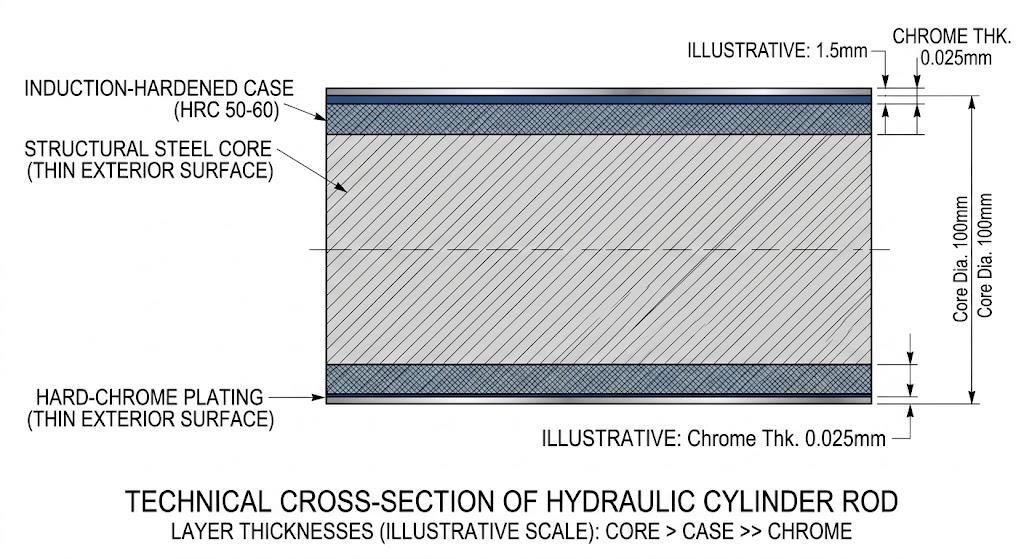
A thin hard-chrome layer, typically in the region of 20–30 microns, is deposited on a ground and polished rod. It gives a very hard, low-friction, corrosion-resistant running surface that is kind to the seal and resists the dust and moisture a rod meets between strokes. What it does not do is make the rod stiffer or stop it buckling — the chrome is far too thin to change how the rod behaves as a structural member.
Induction hardening
Induction hardening heats the surface layer and quenches it to produce a hard case — commonly around 50–60 HRC over a case a millimetre or two deep — while leaving a tougher core beneath. On a rod this resists denting and scoring from grit and impact, which is why mobile, construction and agricultural equipment so often specifies it. The case depth achievable, and how cleanly it forms, depends on the base grade's carbon and alloy content — another reason the base-bar choice comes first.
Sizing a Rod Against Buckling
Buckling is the failure most likely to catch a designer out, because it has little to do with how strong the steel is and a lot to do with how slender the rod is. A long, thin rod under compression behaves as a column, and its resistance depends on its diameter, its effective length (which the mounting style sets), and the stiffness of the steel.
Here is the part that surprises people: for a genuinely long, slender rod, changing grade barely helps. Every steel shares essentially the same elastic modulus — around 210 GPa — so EN8, EN19 and EN24 are equally stiff. In that regime the fix is geometry: a larger rod diameter, a shorter effective length, or a stop-tube to change the buckling mode.
Grade earns its keep as the rod gets shorter and stockier, where failure shifts from pure elastic buckling toward yielding. In that practical middle ground — the slenderness most industrial rods actually run at — a higher-yield grade such as EN19 raises the buckling margin, which is one more reason heavy-duty rods move to the alloy. The honest summary: size the diameter for buckling first, then choose the grade for fatigue, hardness and the surface treatment it has to carry.
Where EN24 and the Bigger Sections Come In
When a rod or pin gets genuinely large in diameter, hardenability becomes the deciding factor. EN24 (817M40) adds nickel on top of EN19's chromium and molybdenum, and that nickel is what lets the steel through-harden in heavy sections where EN19 would start to lose properties toward the core. For large cylinder rods, gland components, clevis pins and the heavily loaded pivot pins on mobile equipment, EN24 buys toughness and consistent strength right through the section. It is the grade to reach for when the part is big and the duty is severe — and it is the step up this site covers in detail in our note on EN24T bright bar cut to size.
Specifying and Buying the Bar
Most standard rods are bought as pre-finished chrome-plated or induction-hardened-and-plated bar, ready to cut and machine the ends. But a great deal of hydraulic work is not standard: custom rod lengths, oversized or non-stock diameters, rod eyes and clevises, glands, piston heads and the pins that hang a cylinder on a machine are all machined from plain alloy bar in the shop. That is where the base-grade decision is yours to make, and where buying the right bar matters.
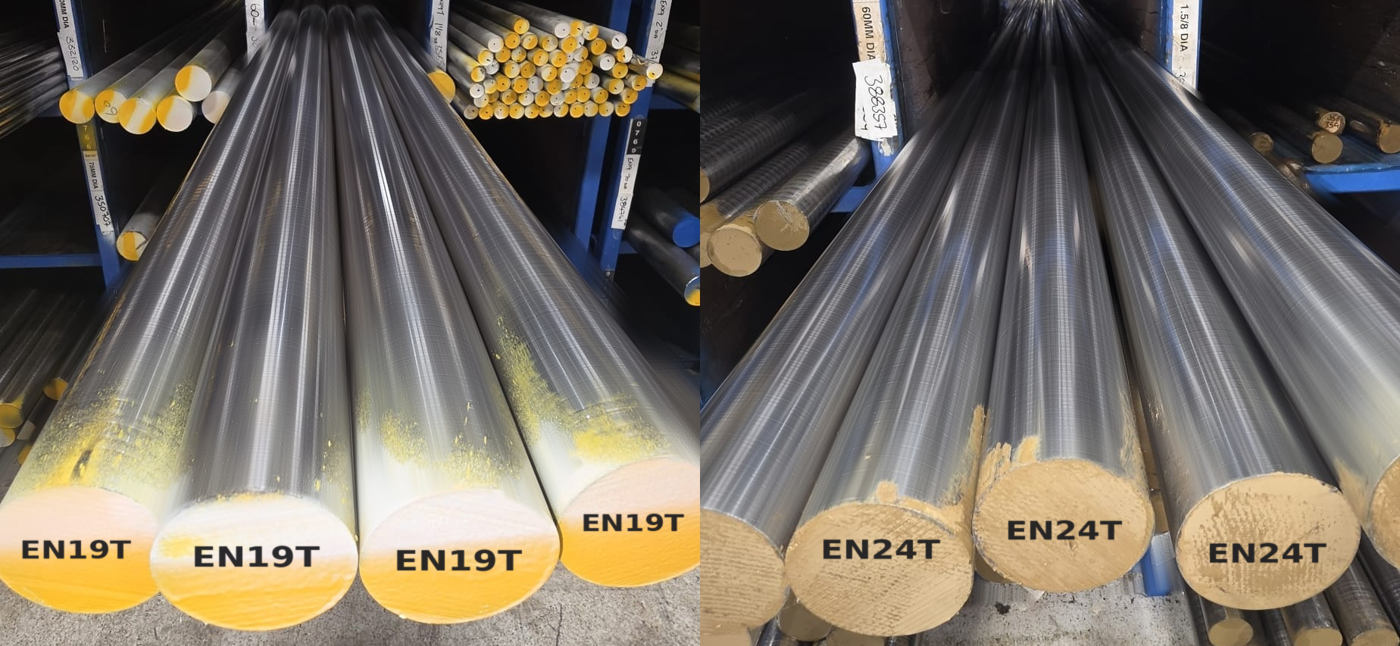
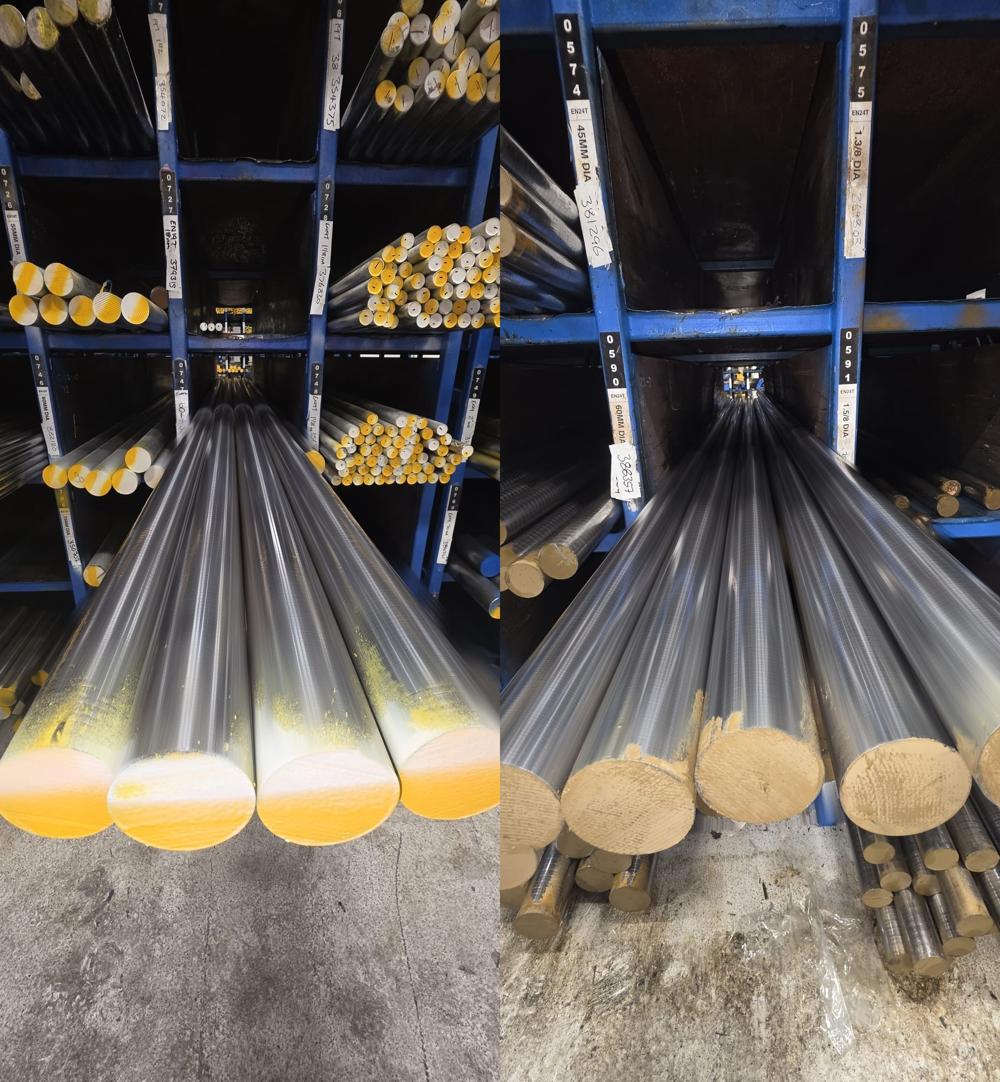
Parkside holds EN8, EN19 and EN24 in stock in both bright and black round bar, and supplies the engineering shops, fabricators and hydraulic cylinder manufacturers that machine their own rods and cylinder parts. We cut to length from stock across 13 saws from 10mm to 600mm diameter, so you buy the material the job needs rather than a mill's minimum run, and every consignment carries EN 10204 material certification with full heat traceability — which matters when a rod failure has to be traced back to a cast. Where a part needs to hold a close diameter or a fine finish before plating or final grinding, our guide to bright bar tolerances sets out which finish actually holds which band.
Machining your own rods, glands or pins? Tell us the grade, diameter and quantity and we will confirm stock and cut it to length.
One boundary worth drawing: this is the base bar, not the finished rod. Plated and induction-hardened rod is bought to its own specification — Parkside is the step before it, which is where it matters that you can see every stocked diameter in EN8D, EN19T and EN24T before committing a cut.
► Request a QuoteWhat to Check Before You Order
- Size the diameter for buckling first. Work out the rod's effective length from the mounting style and the thrust it carries, then size the diameter. Do this before you pick a grade, because for a slender rod the diameter — not the steel — is what stops it bowing.
- Match the grade to the duty. EN8 for general and medium-pressure work; EN19 where pressure, stroke, side load or fatigue life push harder; EN24 for large sections where through-hardness and toughness matter.
- Specify the surface separately. Decide hard chrome for corrosion and seal life, and add an induction-hardened case where grit and impact are a risk. Remember the surface does not change the structural sizing.
- Confirm the base grade behind a plated rod. If you are buying finished chrome rod, ask what the core steel is — a C45/CK45 core and a 42CrMo4 core are not interchangeable for a demanding duty, even if the plated surface looks identical.
- Keep the certificate. Ask for EN 10204 certification on the base bar so a cast can be traced if a rod is ever investigated. It is cheap on the way in and invaluable after the fact.
Our View
There is no single "best" steel for a hydraulic rod, and anyone who gives you one without asking about pressure, stroke and mounting is guessing. The sensible process is boring and reliable: size the rod for buckling, pick the grade for the load and the surface treatment it has to carry, and specify the chrome and the case-hardening as deliberate choices rather than a bundled default. For most rods that lands on EN8; for the hard-working ones it lands on EN19; for the big ones, EN24.
What a stockholder adds to that is practical rather than clever: the right grade on the shelf, cut to the length you actually need, certified so it can be traced, and on a delivery you can plan around. If you are specifying a rod or machining cylinder components and want to talk through which grade and size fits the duty, call us — that is exactly the kind of conversation our sales desk is good at.
Speak to the Parkside Team
Our sales team is on the phone Mon-Fri 08:00-17:00. No minimum order. Next-day available on most lines.