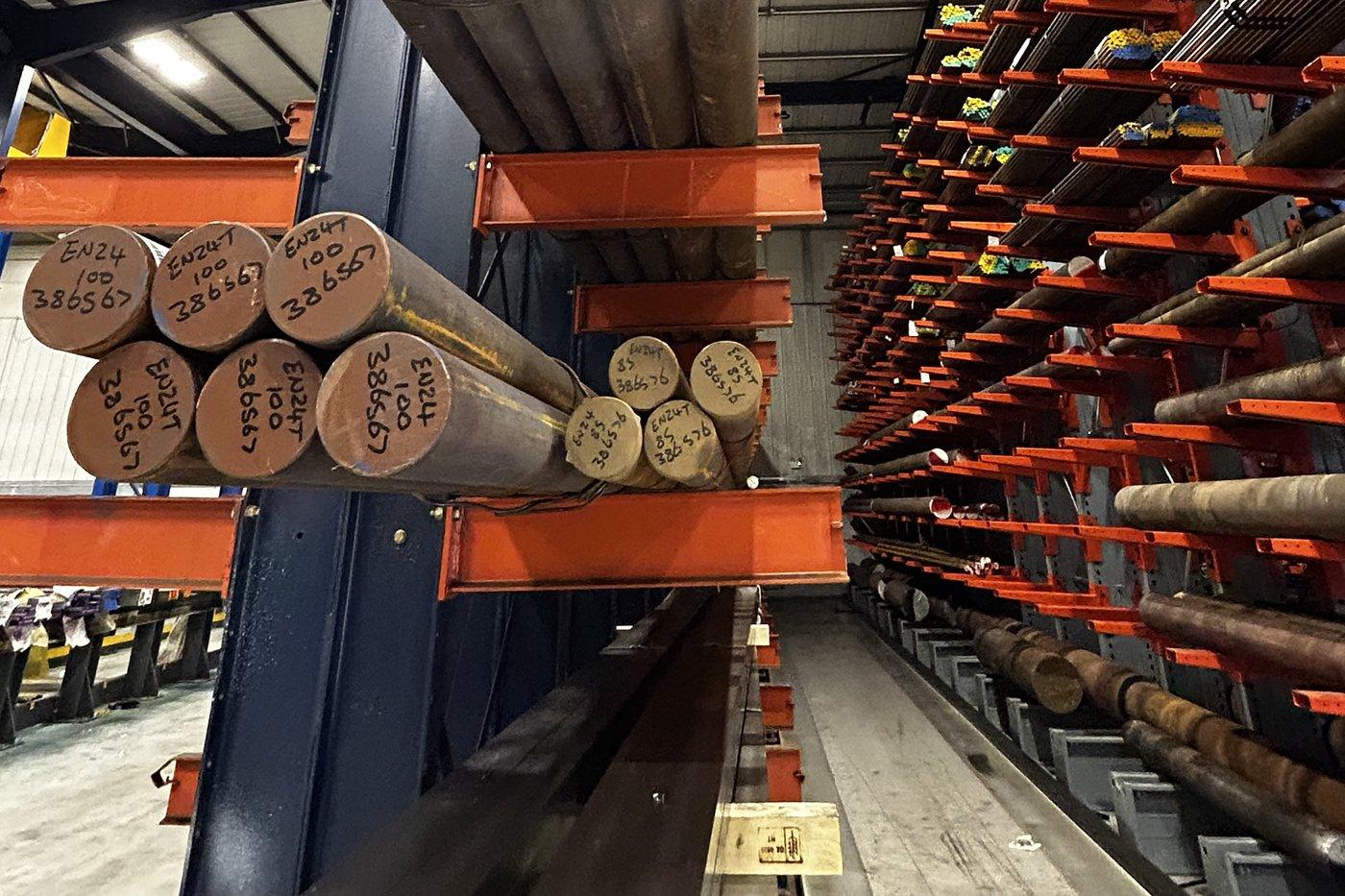
What Makes EN24T Different From EN19
EN24T is the old British Standard designation for 817M40 in the T (quenched and tempered) condition. Strictly the grade is EN24 — 817M40 — and the T marks the condition it is supplied in, which is how our EN24 data sheet lists it. Drawings, stock lists and the chalk on our own bar ends all say EN24T, so that is the term used here. The closest European match under BS EN 10083-3 is 34CrNiMo6 (Werkstoff 1.6582), though some suppliers reference the related 40CrNiMo6 (1.6565) instead; AISI/SAE 4340 is the nearest US analogue, but 4340's specification is looser than 817M40's tighter chemistry and property controls, and JIS lists it as SNCM439. Like EN19 (708M40), it is a chromium-molybdenum alloy — what sets EN24T apart is nickel, typically 1.30–1.70% by weight, added on top of the chromium and molybdenum already in the mix.
Each element does a specific job. Nickel gives toughness, particularly at low temperature, so the steel resists brittle failure under shock loading. Chromium adds depth of hardenability, carrying the hardening effect into the core rather than just the surface. Molybdenum resists the temper brittleness that can otherwise develop when tempering thick sections. Together, this is what lets EN24T deep-harden further into a section and keep its toughness where EN19 would start to lose impact resistance at the core — see our EN19 vs EN24T comparison for where the line between the two actually sits.
The Numbers Change With Section Size
This is the detail that catches people out: EN24T in the standard hardened-and-tempered (T) condition is not published as a single tensile figure. It is published across four section-size bands, and the strength drops as the diameter goes up — an unavoidable consequence of how far heat can penetrate a bar during quenching.
| Condition | Size (mm) | Tensile Rm (N/mm²) | Yield Re (N/mm²) | Elongation A% min |
|---|---|---|---|---|
| H&T (T) | ≤16 | 1150 | ≥900 | 10 |
| H&T (T) | >16–40 | 1000 | ≥800 | 10 |
| H&T (T) | >40–63 | 900 | ≥700 | 11 |
| H&T (T) | >63–100 | 800 | ≥600 | 11 |
| Normalised | All | ~860 | ~600 | ~14 |
The normalised row is shown for reference — it is not a stocked Parkside line. Our stock is the T (hardened and tempered) condition and black bar; EN24 in annealed or as-rolled condition can be sourced on request.
Read against the wrong band and the design maths stops adding up. Spec a large-diameter shaft against the ≤16mm figures and the delivered bar will fall short of what the calculation assumed. Spec a small pin against the >63mm figures and you have left strength on the table that the bar was actually capable of. Always check the property band against the bar diameter you are ordering, not just the grade name on the drawing.
Where EN24T Actually Gets Specified
The applications that call for EN24T are the ones where a component is both highly stressed and has to survive a fatigue life, not just a single load case:
- Heavy-duty shafts, axles and spindles
- High-performance gears and pinions
- Automotive and drivetrain components — connecting rods, drive shafts, axle shafts
- Defence and aerospace structural components
- Oil and gas downhole and pressure components
- Large forgings and ring-rolled sections
- High-tensile bolting to aerospace grade
- Hydraulic cylinder rods and pistons
Where a job does not need EN24T's full hardenability — a smaller section, a less demanding load case, or a tighter budget — EN19 (708M40) is usually the more cost-effective choice and is worth checking first. Where the opposite is true and a component needs extreme surface wear resistance alongside a tough core, EN24T can also be nitrided or direct surface hardened — worth raising with your heat treater alongside the core specification.
The Cost Nobody Prices In: Scrap From Mill Minimums
Mills that roll 817M40/34CrNiMo6 sell by the cast, not by the metre — a mill order is sized in tonnes, not the six 80mm-diameter blanks a job actually needs. Buy direct for a small job and the balance either sits as inventory tying up cash, or ends up as scrap.
Buying cut to length from a stockholder inverts that arithmetic: the piece you are charged for is the piece you use. No mill minimum, no leftover length to store or write off.
Need EN24T cut to a specific length, with the right certificate? Send us the diameter, length and quantity and we will confirm stock and price.
► Request a QuoteCertification and Traceability
Because EN24T is most often specified for fatigue-critical or safety-related components, the certificate matters as much as the chemistry. We supply EN 10204 2.2 and 3.1 on this grade from stock — see our material certification page for how that traceability works end to end. Cutting bright bar to a ground or drawn tolerance? Our note on bright bar tolerances sets out the h9/h11 and drawn bands you will see quoted.
What Should You Do Now?
- Match the property band to the actual bar diameter you are ordering, not just the grade name — the difference between the ≤16mm and >63mm figures is substantial.
- Check whether EN19 covers the job first. If the section is smaller or the load case less demanding, EN19 is usually the more economical grade — compare the two directly before defaulting to EN24T.
- Size the order to the job, not the mill minimum. Ask a stockholder what is held in the diameter you need before committing to a full cast quantity.
- Specify the certificate type up front — EN 10204 2.2 or 3.1 — so it is confirmed at order stage, not chased at goods-in.
- Plan for preheat and post-weld heat treatment if welding is involved; this is heat-treated bar, and it behaves like it.
Our View
EN24T earns its place in a highly-stressed shaft or gear because its hardenability holds up in larger sections where a leaner grade would not — but that same sensitivity means the datasheet has to be read against the actual bar diameter, not treated as one number. Get that right, and the rest is straightforward: specify the certificate you need, and buy the length you need.
We have stocked and cut alloy bar at Sherwood Park for nearly five decades. If you are not sure whether a job needs EN24T or EN19, or you want a quote sized to the actual quantity rather than a mill minimum, call us — that is exactly the kind of question our team fields every day.
Speak to the Parkside Team
Our sales team is on the phone Mon-Fri 08:00-17:00. No minimum order. Next-day available on most lines.