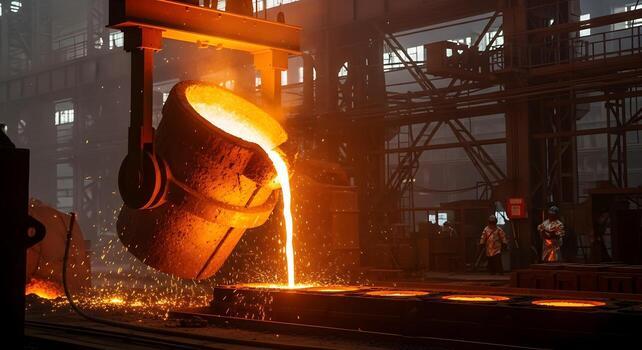
What "Melt and Pour" Means
"Melt and pour" (sometimes written "melt and cast") is the point at which raw steel is first produced — where scrap or iron is melted and the liquid steel is cast into its first solid form, whether an ingot, a bloom or a continuously cast billet. Everything that happens afterwards — rolling into bar, drawing, turning, grinding, cutting to length — is downstream processing. The country of melt and pour is therefore the true origin of the steel itself, regardless of where it was later rolled or finished.
That distinction matters because a bar can change hands and cross borders several times between the furnace and the machine shop. Steel melted in one country can be rolled in a second and shipped from a third. Trade authorities want to close the gap that lets material dodge quotas and duties simply by being processed somewhere else on the way. The country of melt and pour is the fact they have decided to pin down.
What Changes on 1 October 2026
On 31 August 2026 the European Commission adopted the implementing act that sets out exactly how importers must prove country of melt and pour under the new EU Steel Regulation (Regulation (EU) 2026/1384, with the evidence rules in Implementing Regulation (EU) 2026/1963). The requirement applies from 1 October 2026.
From that date, anyone importing a steel product covered by the regulation into the EU must declare on the customs declaration the country in which the steel was melted and poured, and be able to support that declaration with evidence. If suitable and verifiable evidence is not provided, the importation can be refused. This sits on top of the new EU and UK steel safeguard measures that replaced the old regime on 1 July 2026, under which above-quota steel now attracts a 50% out-of-quota tariff.
What Evidence Now Counts
The Commission has been specific about the paperwork. The primary document is a mill test certificate that states the country of melt and pour and carries the heat number of the material. Where a mill certificate does not give that information, or cannot be produced, a defined list of supporting documents can be used — invoices, delivery notes, quality certificates, clauses in purchase orders or contracts, supplier declarations and exporting-country customs documents — provided each one shows both the country of melt and pour and the heat number.
There is a deadline built into that flexibility. Until 30 September 2027 those supporting documents can stand alone as evidence. From 1 October 2027 they are only accepted as complementary to a mill test certificate — not in place of one. In other words, the mill certificate moves from "strongly preferred" to effectively mandatory within a year.
| Evidence | Must show | To 30 Sep 2027 | From 1 Oct 2027 |
|---|---|---|---|
| Mill test certificate | Country of melt & pour + heat number | Primary evidence | Primary evidence |
| Invoice / delivery note | Country of melt & pour + heat number | Accepted standalone | Complementary only |
| Quality cert / supplier declaration | Country of melt & pour + heat number | Accepted standalone | Complementary only |
| PO / contract clause / customs docs | Country of melt & pour + heat number | Accepted standalone | Complementary only |
Why This Reaches UK Engineers and Fabricators
The declaration itself is an EU import requirement, so on the face of it a UK-to-UK transaction is unaffected. But the reach is wider than that for two reasons.
You may be the exporter. A large share of Parkside's customer base — fabricators, CNC machining shops, hydraulic cylinder manufacturers and drivetrain suppliers — sells finished or semi-finished steel work into Europe. Where a shipment falls under the EU steel measures, an EU customer or their broker will now ask for melt-and-pour evidence with the heat number before goods clear. If you cannot pass that proof down the chain, the material can be held or refused at the border. The place to fix that is upstream: make sure the origin and heat number are captured the moment the steel enters your yard, not chased after an order has shipped.
The direction of travel is one-way. Origin and traceability are being written into trade rules on both sides of the Channel. The UK's own steel measure tightened quotas and raised the out-of-quota tariff to 50% from 1 July 2026, and the UK Carbon Border Adjustment Mechanism arrives on 1 January 2027, adding a carbon charge on imported iron and steel. None of these change what a mill certificate contains, but all of them reward buyers who already know their material's origin and keep clean documentation through the supply chain — and penalise those who do not.
The Parkside Position
Traceability is not something Parkside has to bolt on for this rule — it is how the yard already runs. Every bar in stock at Sherwood Park is identity-marked with its grade and, where applicable, its heat number, and every consignment is traceable back to its mill certificate, which records the material's origin. When we cut a bar to length, the cut pieces stay linked to that original certificate, so a part machined from Parkside steel can still be traced to the heat it came from and the country it was poured in. We supply EN 10204 2.2 and 3.1 certificates on our alloy grades from stock, with 3.2 available by arrangement, and we can retrieve a certificate for an order placed months ago. If your EU customer needs melt-and-pour proof with the heat number, that is exactly the paper trail our certification is built to provide. You can read more on our accreditations and material certification page, and our guide to reading an EN 10204 mill certificate explains the fields in detail.
Need certified engineering bar with full heat traceability, cut to length from stock? Tell us the grade, size and certificate type and we will confirm availability.
► Request a QuoteWhat to Do Now
A short, practical checklist for buyers and quality teams ahead of 1 October:
- Find out where your steel is melted, not just where it ships from. Ask suppliers for the country of melt and pour on the mill certificate for the grades you buy — before you need it at a border.
- Capture the heat number at goods-in. Record it against each delivery and keep it linked to the material as it moves through your process, so the trail is never broken.
- Insist on the mill certificate. Standalone alternatives are accepted only until 30 September 2027. Buying from a stockholder who supplies EN 10204 certificates as standard puts you on the right side of that deadline now.
- Check origin against the certificate, not the invoice. Confirm the melt-and-pour country from the mill document — it will not always match the "country of origin" on shipping paperwork.
- Tell your EU customers what you can prove. If you export, confirm up front that you can pass melt-and-pour evidence with the heat number down the chain. It is far cheaper to establish that now than at a held shipment.
If you machine or export alloy grades such as EN24 (817M40) or EN19 (708M40), the certificate that travels with the bar is now part of the deliverable, not an afterthought. Buying certified material cut to length from stock, with the heat number preserved on every piece, keeps that trail intact from the furnace to the finished part. If any of the grade designations on a certificate look unfamiliar, our grade equivalents table maps the common EN, BS and European names side by side.
Our View
The melt-and-pour rule is not a burden on companies that already keep proper certification — it simply makes explicit what good engineering practice has always demanded: know where your steel came from and keep the paper that proves it. The firms that will be caught out are the ones who buy on price alone, take material without a mill certificate, and lose the heat number somewhere between goods-in and dispatch. The fix is the same discipline that a proper mill certificate has always rewarded: capture the origin and the heat number once, keep them attached to the material, and the border question answers itself.
If you are not sure whether the material you buy can carry melt-and-pour proof through to your customer, or you want certified bar cut to length from stock, call us. That is exactly the kind of practical question our team answers every day.
Speak to the Parkside Team
Our sales team is on the phone Mon-Fri 08:00-17:00. No minimum order. Next-day available on most lines.