📍 Byron House, 4 Willow Drive, Sherwood Park, Annesley, NG15 0DP
Mon–Fri 08:00–17:00 📞 01623 687 660 ✉ sales@parksidesteel.uk.com
Industry Grade Guide

Engineering Steel for
Hydraulics & Pneumatics.

Hydraulic and pneumatic components require precise dimensional tolerances, excellent surface finish after machining, and in many cases a very hard, wear-resistant surface for long seal life and corrosion resistance. The move from hard chrome plating to nitriding on hydraulic cylinder rods has made EN40B (722M24) the most important alloy grade in this sector — and one of the grades that most clearly demonstrates why specifying correctly from the start matters.

Sector Overview

What Hydraulic & Pneumatic Components Need

Hydraulic cylinder rods fail for two reasons: surface wear destroying the seal interface, or fatigue cracking in the core under repeated extension and retraction cycles. The solution to both is EN40B in the Q+T condition, gas nitrided after final grinding.

The nitriding process produces a surface hardness of 700–850 HV (approximately 65–70 HRC equivalent) with compressive residual stresses that improve fatigue life — while the chromium-rich compound layer resists corrosion and mild chemical attack better than hard chrome. And critically, because nitriding is carried out at low temperature (480–530°C) with no quench, the finished rod does not distort — essential for long cylinder bores with tight tolerances.
Key Grades

At a Glance.

Full grade list below ↓

Hydraulic Cylinder Rods — Nitrided

EN40B (722M24 / 31CrMo12) is the premier grade for nitrided hydraulic cylinder rods. Supplied in the Q+T condition, precision-ground and gas nitrided to 700–850 HV surface hardness, it provides a wear and corrosion resistant surface that outlasts hard chrome in most applications — without the environmental concerns associated with hexavalent chromium plating.

The gas nitriding process produces minimal dimensional change — typically less than 0.01mm change in diameter after a standard nitriding cycle. This means the rod can be ground to final tolerance and diameter before nitriding without dimensional allowance for heat treatment distortion. The resulting component is dimensionally stable, hard on the surface and tough in the core — the combination that makes hydraulic cylinders last.

Recommended Grades

Valve Spools, Fittings & High-Volume Turned Parts

Hydraulic valve spools and fittings are produced in large quantities on CNC lathes and automatic screw machines — making machinability the primary grade criterion alongside adequate strength. EN1A (230M07 / 11SMn30) is ideal for valve spools, fittings, unions and connector bodies where the component geometry is complex and surface finish is important but strength requirements are modest.

For fittings requiring greater strength — or where the component also functions as a structural element — EN19 (42CrMo4) in the normalised condition gives the required strength with reasonable machinability. For hex-head fittings and valve bodies produced on automatic lathes, EN1A in hexagon bar form eliminates the preliminary turning to hex profile required from round bar.

Recommended Grades

Pump Shafts, Pistons & Actuator Components

Hydraulic pump shafts and piston rods require high tensile strength to transmit power, good fatigue resistance under cyclic loading, and dimensional stability in service. EN19 (42CrMo4) covers the majority of pump shaft applications — its high tensile strength (900–1100 N/mm² in T condition), good corrosion resistance relative to plain carbon steels, and consistent hardenability make it the default choice.

For heavy-duty pump shafts in large industrial or mobile hydraulic systems where higher toughness is required — particularly in cold-climate or impact applications — EN24T (817M40T) adds nickel for improved deep-section hardenability and toughness at lower temperatures.

Recommended Grades
All Grades for Hydraulics & Pneumatics

Recommended Grades — Full List.

Click any grade for full data sheet, chemical composition, mechanical properties and heat treatment guidance.

Not sure which grade is right? Call our sales team on 01623 687 660 — we can advise based on your component, loading and heat treatment requirements.

Common Questions

Frequently Asked.

EN40B (722M24 / 31CrMo12) is the correct grade. It must be supplied in the Q+T condition before nitriding. The high chromium content (2.8–3.3%) ensures strong chromium nitride formation during gas nitriding, giving 700–850 HV surface hardness with minimal dimensional change.
EN40B is specifically designed for nitriding — the high chromium content responds to the nitriding atmosphere to create a very hard compound layer. EN19 can be nitrided but gives a lower surface hardness response than EN40B. For nitrided rods, EN40B is the correct specification. For rods that are not nitrided, EN19 in T condition is the standard choice.
Yes. EN40B bright bar is stocked in the Q+T (quenched and tempered) condition — the core properties are established and the bar is ready for precision grinding and nitriding without further heat treatment.
Explore Further

Related Industries.

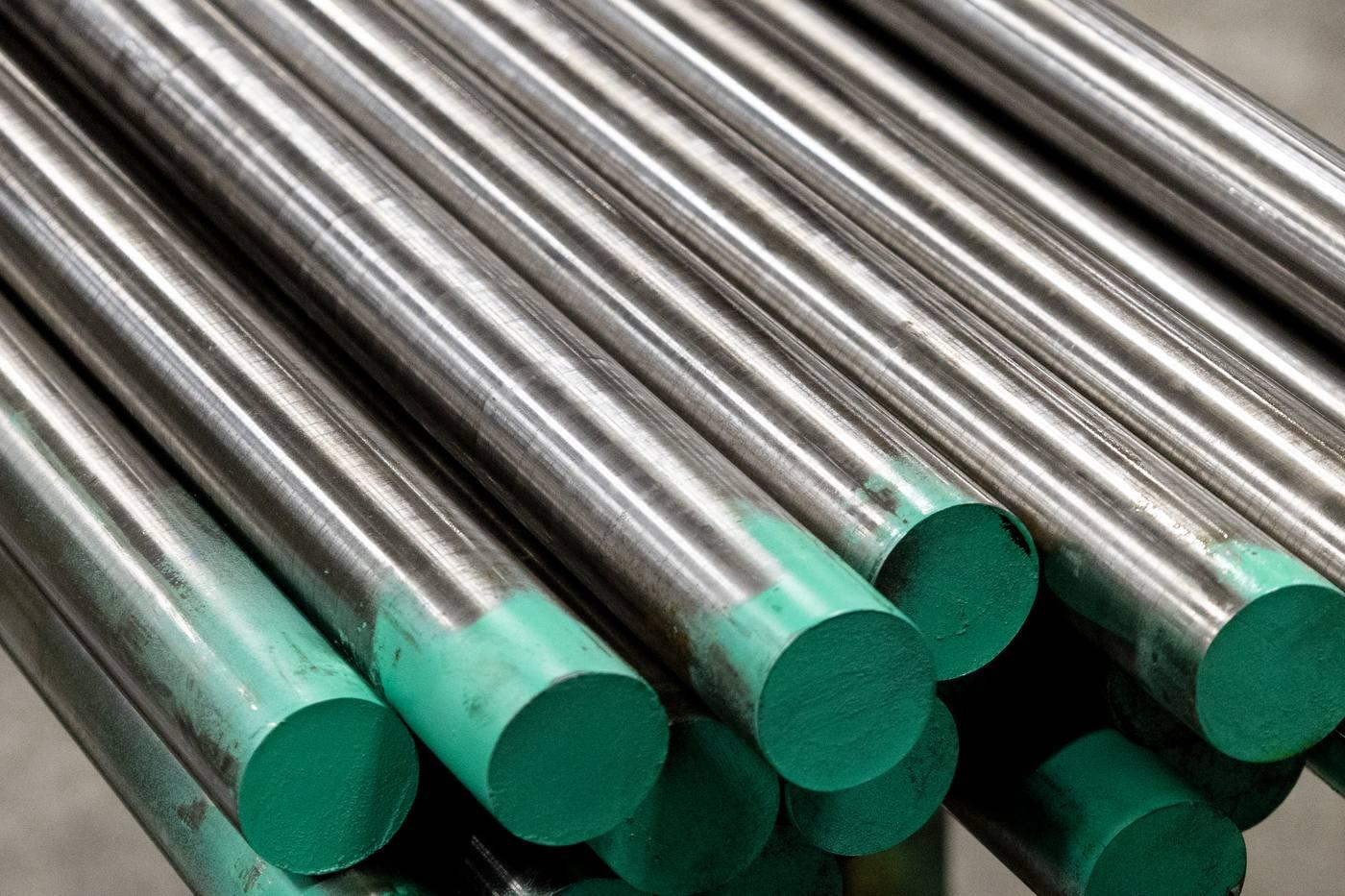
Bright round bar with green colour-coded ends — nitriding grade for hydraulic cylinder rods
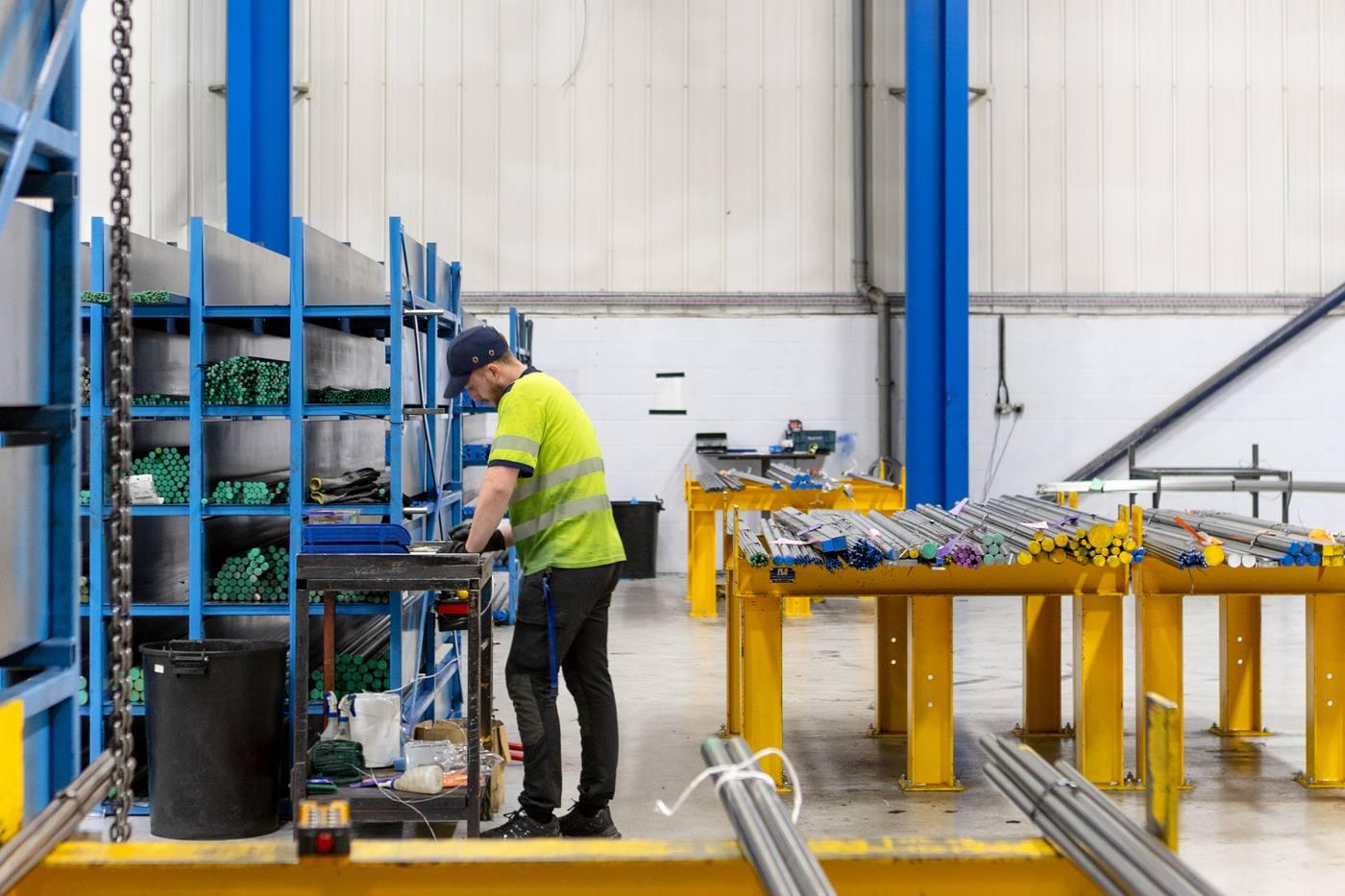
Operative at despatch station with bright bar on yellow outfeed tables — ready for delivery

Talk to Us About Your Hydraulics & Pneumatics Requirements.

EN40B stocked in Q+T condition — ready for nitriding. Our sales team understands engineering steel — not just the catalogue. Call with a grade, a component description, or a question.