EN19 and EN24 are both chromium-molybdenum alloy steels, but EN24 adds nickel for deeper hardenability and better toughness in large sections. Knowing when the upgrade is justified — and when EN19 is sufficient — is the key decision for engineers specifying high-tensile components.
| Property | EN19 (708M40 / 42CrMo4) | EN24 (817M40 / 34CrNiMo6) |
|---|---|---|
| Carbon content | 0.35–0.45% | 0.36–0.44% |
| Key alloy additions | Cr 0.90–1.20%, Mo 0.15–0.40% | Cr 1.00–1.40%, Mo 0.20–0.35%, Ni 1.30–1.70% |
| Supply condition | Normalised or Q+T (specify) | Pre-treated Q+T (T suffix) |
| Tensile strength (Q+T, ≤40mm) | 900–1100 N/mm² | 950–1150 N/mm² |
| Tensile strength (Q+T, >63mm) | 750–950 N/mm² | 850–1000 N/mm² |
| Through-hardening section | ~65mm reliable | >100mm reliable |
| Impact toughness | Good | Excellent — Ni improves toughness |
| Low-temperature toughness | Moderate | Good — Ni maintains toughness |
| Weldability | Difficult — preheat required | Very difficult — specialist procedure |
| Relative cost | Lower | Higher (Ni alloy premium) |
| Pre-treated supply | Available (T condition) | Standard (817M40T) |
| Aerospace/defence use | Some applications | Primary specification grade |
| AISI equivalent | 4140 | 4340 |
| DIN equivalent | 42CrMo4 / 1.7225 | 34CrNiMo6 / 1.6582 |
| 3.1 cert available | Yes | Yes |
The addition of 1.30–1.70% nickel to EN24 (vs no nickel in EN19) does two things: it improves deep-section hardenability by stabilising austenite during the quench — allowing martensite to form even in sections well above 65mm — and it improves toughness, especially at low temperatures.
The pre-treated (T suffix) supply condition of EN24 means the bar arrives with guaranteed mechanical properties throughout its cross-section. The end user machines it directly to drawing — no further heat treatment is required and no quench distortion risk is introduced.
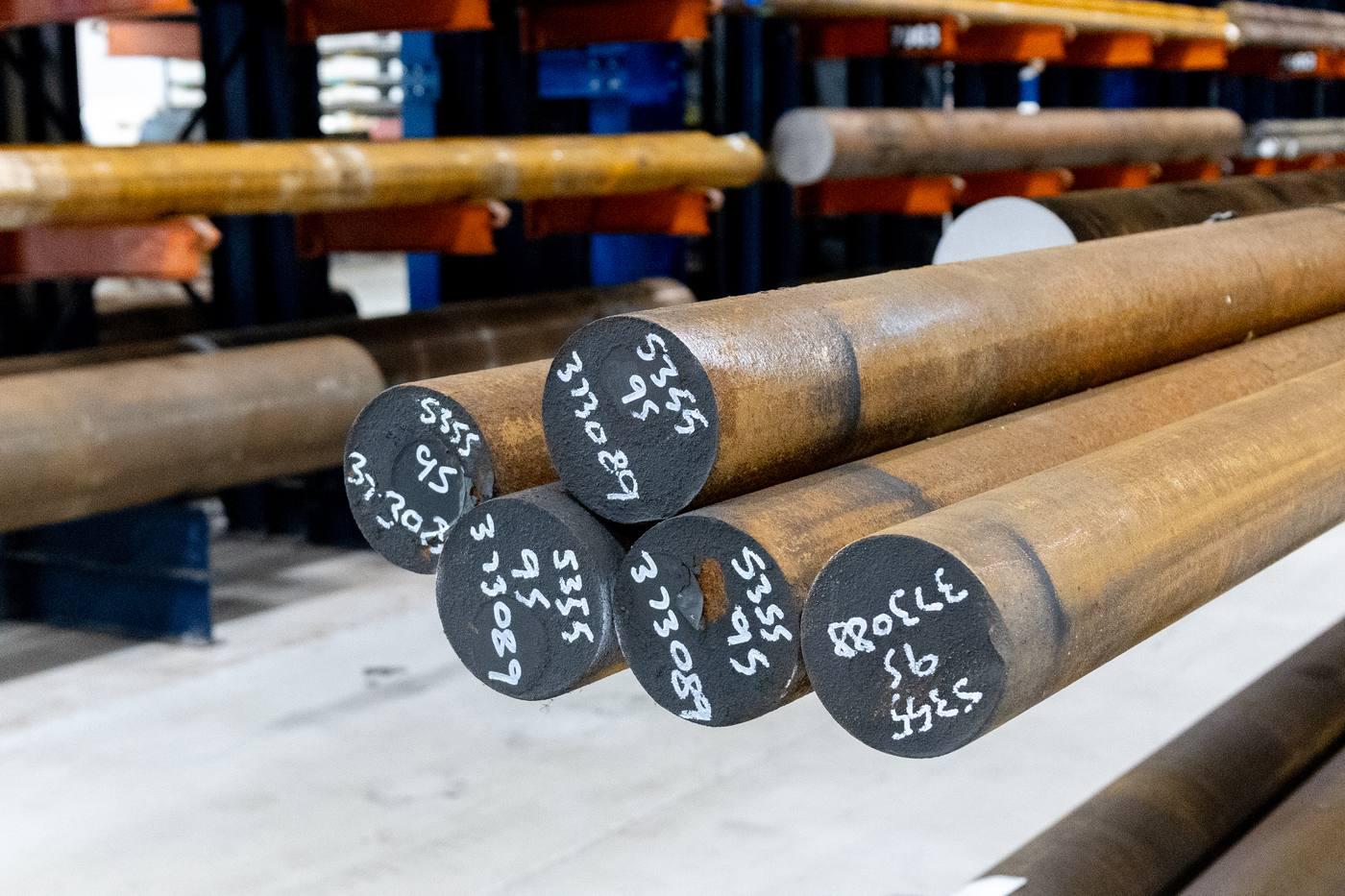
EN19 bright and black bar. EN24 pre-treated bright and black bar. Cut to length from one piece. 3.1 certs standard on both.