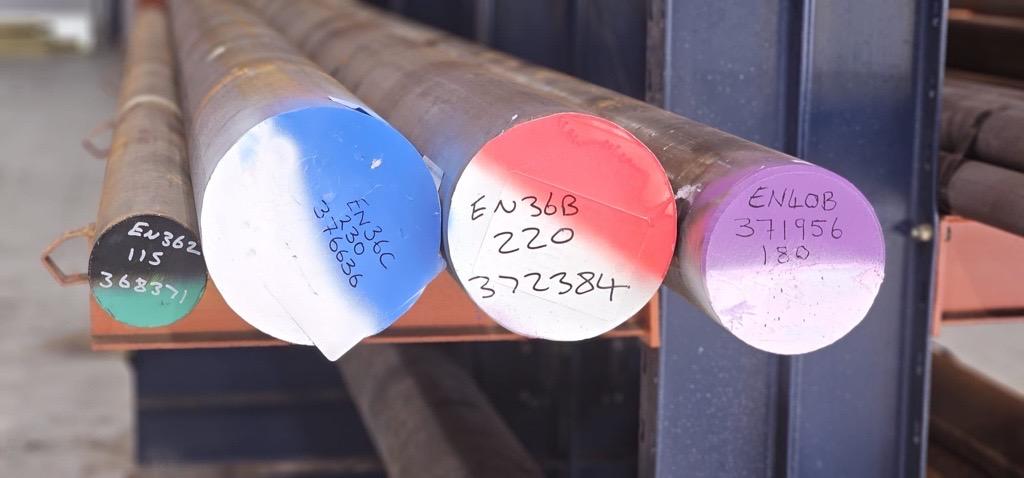
The Problem EN36 Is Built For
A loaded gear tooth, a pinion, a splined shaft or a bearing race all meet the same contradiction in service. The working surface is pressed, rolled or meshed against another hard face and has to resist pitting and wear, so it wants to be hard. The body of the part has to absorb shock and bending without fracturing, so it wants to be tough. One uniform hardness cannot deliver both: harden it throughout and it turns brittle; leave it soft and the teeth pit away.
The engineering answer is to make the surface and the core deliberately different — a hard case over a tough core. For a steel that already carries enough carbon of its own, you can heat the surface and quench it, which is the surface-hardening route EN9 takes. But the highest-duty gears want a deeper case and a core that stays genuinely tough under load, so you start with a low-carbon alloy steel and add carbon to the skin by carburising. EN36 (655M13) is one of the classic steels for exactly that job.
Where EN36 Sits — 3% Nickel-Chromium, Built to Carburise
EN36 is a low-carbon alloy case-hardening steel. In the plain form, 655M13, it carries roughly 0.12–0.18% carbon with about 3% nickel and around 0.6–1% chromium. The low base carbon is deliberate: it is what keeps the core soft and tough after hardening, and it is why the grade needs carburising to build a hard surface rather than arriving hard on the bar.
The alloy does the heavy lifting. The nickel raises the toughness and shock resistance of the core, which is the property that matters when a tooth is hammered by a sudden load. The chromium increases hardenability and helps the case harden uniformly. The molybdenum-bearing variant, EN36C (832M13), adds 0.10–0.25% molybdenum to push hardenability further and strengthen the core in heavier sections, which is why EN36C is the choice when the part is large or the core has to carry more. Their full international names sit on our grade equivalents table.
How Carburising Works on EN36
Carburising adds carbon to the surface of a low-carbon steel at high temperature, then hardens that carbon-enriched skin by quenching. On EN36 the sequence runs roughly like this:
- Carburise. The machined part is held in a carbon-rich atmosphere, salt bath or pack at around 880–930 °C, and carbon diffuses into the surface. Time at temperature sets the case depth — longer gives a deeper case.
- Harden. The part is quenched, usually in oil for an alloy steel, so the high-carbon case transforms to hard martensite while the low-carbon core stays comparatively soft and tough. A refining and re-hardening step is often used to control grain size in the case and core.
- Temper. A low-temperature temper relieves quench stresses without softening the case appreciably.
The result is a wear-resistant case typically in the region of 58–62 HRC over a core that keeps the toughness of the un-hardened alloy — the exact hard-face-over-tough-core split a loaded gear needs. Case depths from a few tenths of a millimetre to a couple of millimetres are routine, tuned by carburising time to the gear's module and load. Our heat treatment guide sets the processes side by side; the case hardening steel guide covers the carburising route itself.
EN36 vs 8620 vs EN36C — Choosing the Grade
EN36 is one of three case-hardening grades a gear or shaft maker is most likely to weigh up. They are not interchangeable — the choice turns on section size, core strength and cost.
| Grade | Alloying | Hardenability / core | Best suited to |
|---|---|---|---|
| 8620 (805M20) | ~0.5% Ni, Cr, Mo — lean alloy | Moderate; lighter cores | High-volume, smaller carburised gears and pins where a leaner, lower-cost grade carries the load |
| EN36 (655M13) | ~3% Ni, ~1% Cr | Good; tough, shock-resistant core | Heavily loaded gears, pinions and shafts needing a tough core under impact |
| EN36C (832M13) | ~3% Ni, Cr + ~0.2% Mo | Highest of the three; strong core in heavy sections | Large or highly stressed carburised parts where the core must stay strong through a thick section |
Read the table by the core, not the case — all three carburise to a similar surface hardness. What separates them is how tough and how strong the core stays, and how large a section they can harden properly. 8620 (805M20) is the lean, cost-effective workhorse for smaller, high-volume parts. EN36 steps up the nickel for a tougher core under shock. EN36C adds molybdenum on top for the heaviest sections. Where the decision is specifically EN36 against the leaner American grade, we keep an EN36 vs 8620 comparison that sets the two side by side.
The Parts EN36 Is Right For
EN36 earns its place wherever a surface has to resist contact wear and the core has to survive shock, and the loads are high enough that a tougher core justifies the nickel. In practice that is the heavy end of the transmission and driveline:
- Gears and pinions — tooth faces carburised hard to resist pitting while the body stays tough under impact loading.
- Splined and drive shafts — torque-carrying shafts with case-hardened journals and spline flanks.
- Gudgeon pins and connecting-rod ends — small, heavily stressed parts that want a hard surface over a tough core.
- Bearing races and rollers — rolling-contact surfaces hardened against fatigue and wear.
- Cams and camshafts — sliding-contact lobes that need a hard working face.
The common thread is high-duty, shock-loaded, rolling- or sliding-contact parts — which is why EN36 and EN36C are long-standing choices in automotive and drivetrain, off-highway and heavy engineering. Carburised alloy gears are seeing renewed interest on electric-vehicle driveline programmes, where high-torque reduction gearsets place exactly that combined wear-and-shock demand.
When to Step Sideways — Nitriding and EN40B
Case hardening by carburising is not the only way to get a hard surface on an alloy steel, and it is worth knowing where a different process wins. Nitriding introduces nitrogen rather than carbon, at a lower temperature and without a quench, so it produces very little distortion and a very hard, thin case — useful where dimensional stability after hardening matters more than case depth. The classic nitriding grade is EN40B (722M24), a chromium-molybdenum steel supplied pre-hardened and tempered before nitriding.
The trade-off is case depth and recovery after wear: a carburised EN36 case is thicker and can be reground more than once over a long service life, whereas a nitrided case is thin and shallow. For a gearset that will be heavily loaded and may be refurbished, EN36 or EN36C is usually the call; for a part that must not move dimensionally after hardening — a precision spindle or a long thin shaft — nitriding and EN40B can be the better route.
Specifying and Buying the Bar
EN36 is bought as soft alloy bar, machined into the finished part, and carburised afterwards — the hardness comes from the heat treater, not the mill. That puts the base-bar decisions on the buyer: the right grade between EN36 and EN36C, a size close to the finished diameter to save machining, and a certificate that ties the steel to its cast so the alloy content behind the case can be traced.
Parkside holds EN36 (655M13) and the molybdenum-bearing EN36C (832M13) in black round bar, for the gear and pinion makers, CNC machining shops and automotive, drivetrain and heavy-engineering customers who machine their own carburised parts. We cut to length from stock across 13 saws from 10mm to 600mm diameter, and every consignment carries EN 10204 material certification with full heat traceability — which matters when the alloy content governs how the case and core respond to carburising. Where a part has to hold a close diameter before machining, our guide to bright bar tolerances sets out which finish holds which band.
Machining carburised gears or shafts in EN36 or EN36C? Tell us the diameter and quantity and we will confirm stock and cut it to length.
► Request a QuoteWhat to Check Before You Order
- Confirm the part will be carburised. EN36 pays off only when the surface is case-hardened. If nothing is being hardened, a through-hardening alloy or a plain carbon steel is the better and cheaper choice.
- Match the grade to the section and core. EN36 for a tough core under shock; step up to EN36C (832M13) when the section is heavy or the core must stay strong right through.
- Specify the case depth with your heat treater. Case depth is set by carburising time, so agree it against the gear module and load before the part is hardened.
- Pick the nearest stock size. Ordering close to the finished diameter saves machining time and material — ask what diameters are on the shelf.
- Keep the certificate. EN 10204 certification ties the bar to a cast and its alloy content, so a hardening result can be traced back to the material if it is ever questioned.
Our View
EN36 is a specialist's steel for a specific job: the heavily loaded carburised gear, pinion or shaft that needs a hard, wear-resistant case and a core tough enough to take the shock. Its 3% nickel is what buys the tough core, and the molybdenum in EN36C extends that to heavier sections. Used that way the grade does a job a leaner steel cannot do as well and a plain carbon steel cannot do at all. Used the wrong way — expected to arrive hard, or asked to serve a part that will never be case-hardened — it is simply an expensive soft bar.
What a stockholder adds is the unglamorous part that makes the choice work: the right case-hardening grade on the shelf, cut to the length the job needs, and certified so the alloy that governs the case can be traced. If you are specifying a carburised part and want to talk through whether EN36, EN36C or 8620 fits the duty, call us.
Speak to the Parkside Team
Our sales team is on the phone Mon-Fri 08:00-17:00. No minimum order. Next-day available on most lines.