The Problem EN9 Is Built For
A gear tooth, a sprocket, a cam, a slideway or a tillage tine all meet the same demand in service: the working face slides, meshes or digs against something abrasive, and it has to stay hard enough not to wear away — while the body of the part absorbs shock loads without fracturing. A single uniform hardness cannot do both. A part hard all the way through is wear-resistant but brittle; a part soft all the way through is tough but wears out.
The usual answer is to make the two properties different in different places: a hard case on the surface and a tougher core beneath it. For a free-machining or low-carbon steel you would get that case by carburising — adding carbon to the skin. For a steel that already carries enough carbon of its own, you can skip that step and simply heat the surface and quench it. EN9 (070M55) is squarely in the second camp, and that is the whole reason to choose it.
Where EN9 Sits — More Carbon Than EN8, No Alloy
EN9 is a plain medium-carbon steel with roughly 0.50–0.60% carbon and no deliberate alloying. That carbon figure is the point of the grade. Its close cousin EN8 (080M40) sits near 0.40% carbon, and that extra tenth or so is what lets EN9 reach a harder surface when it is heat-treated. Internationally it is the same steel as C55 / C55E and AISI 1055; you can see the full set of names on our grade equivalents table.
| Grade | Type | Typical carbon | Hardenability | What it is good at |
|---|---|---|---|---|
| EN8 (080M40) | Medium-carbon | ~0.40% | Shallow | General shafts, studs and machined parts; the everyday medium-carbon default |
| EN9 (070M55) | Medium / higher-carbon | ~0.55% | Shallow, but a harder attainable surface | Flame- or induction-hardened wear faces over a tough core |
| EN19 (708M40) | Chromium-molybdenum alloy | ~0.40% | Deep | Through-hardened, higher-strength parts and heavier sections |
The row that matters is the middle one. EN9 is not an alloy steel, so like EN8 it has shallow hardenability — it will not through-harden a thick section the way EN19 (708M40) does. What its higher carbon buys you is a harder surface once that surface is locally heat-treated. If the job is "give this face a hard skin and keep a tough middle," EN9 does it more cheaply and more simply than an alloy grade, because the carbon to form the case is already in the bar.
Flame and Induction Hardening EN9
Because EN9 already holds enough carbon, you harden its surface by heating that surface above its transformation temperature and quenching it fast — no carbon has to be diffused in first. Two processes do this in practice.
Flame hardening
An oxy-fuel flame is played across the surface to heat a thin layer, which is then quenched. It is flexible and low-capital, well suited to large, awkward or one-off parts — think a long slideway, a large sprocket, or a tooth-by-tooth pass on a big gear. The depth and hardness depend on how the heat is applied and how quickly the quench follows.
Induction hardening
A copper coil carrying high-frequency current induces heat in the surface, which is then quenched. It is fast, repeatable and controllable, which makes it the natural choice for volume production of shafts, pins and gears. The frequency sets how deep the heat goes, so the case depth can be tuned to the part.
Either way, EN9 can be taken to a hard, wear-resistant surface — in the region of the mid-to-upper 50s on the Rockwell C scale for a well-controlled case — over a core that keeps the toughness of the un-hardened steel. The processes themselves, and where they sit alongside through-hardening, tempering and nitriding, are set out in our heat treatment guide.
The Parts EN9 Is Right For
EN9 earns its place wherever a surface has to take wear and the body has to take load, and the section is not so large that it needs an alloy steel to harden through. In practice that is a long list of everyday engineering components:
- Gears and sprockets — tooth faces that are flame- or induction-hardened to resist contact wear while the body stays tough.
- Cams, rollers and bushes — rotating or sliding faces that need a hard working surface.
- Shafts and keys — where good strength and a wear-resistant journal or keyway matter more than deep hardenability.
- Slideways and wear plates — guiding surfaces hardened locally where the contact runs.
- Agricultural tillage tools — tines, points and blades that dig abrasive soil, a classic high-carbon-steel duty.
- Hand tools, chisels and punches — parts that want a hard working edge over a body that will not shatter.
The common thread is a hard face doing the work and a tough core carrying the load — the exact split that a surface-hardened medium-carbon steel gives you.
When to Step Up or Down
EN9 is a specific answer, not a universal one, and two neighbours cover the jobs it should not take.
Step down to EN8 when the part does not need a hard surface at all — a general shaft, stud or machined component where strength and machinability matter and there is no wear face to harden. EN8 machines a touch more freely and is the sensible default for ordinary medium-carbon work. The engineering difference between the two is small enough that it is worth seeing side by side, which is why we keep an EN8 vs EN9 comparison.
Step up to an alloy grade when the section is large and has to be hard or strong right through, not just at the skin. EN9's shallow hardenability means a thick bar hardened at the surface stays soft in the core — fine when that is what you want, wrong when the whole section must carry high stress. There the chromium-molybdenum of EN19 (708M40), or a nickel-chromium-molybdenum grade above it, through-hardens the section in a way no plain carbon steel can.
Specifying and Buying the Bar
EN9 is bought as plain bar and machined in the shop, with the hardening done after the part is cut and turned — the surface treatment is one of the last operations, not something that comes on the bar. That makes the base-bar decision yours to get right: the grade, the size closest to the finished part, and a certificate that ties the steel to a cast.
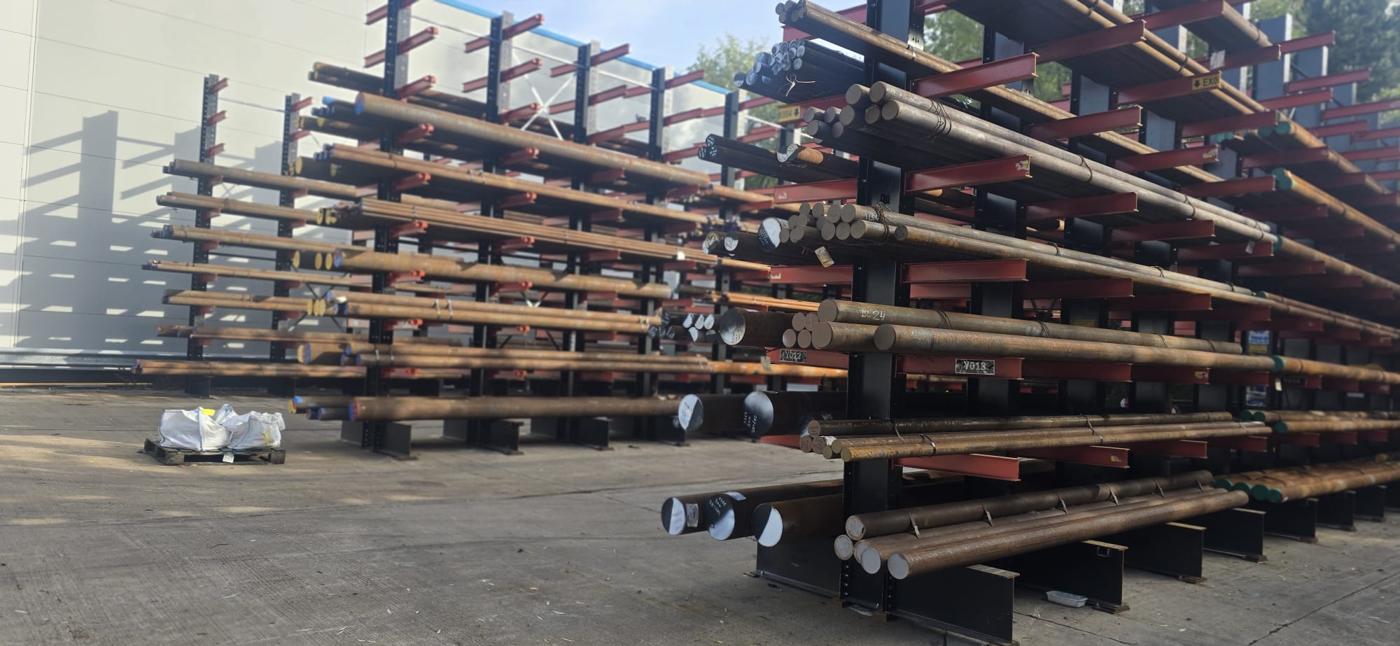
Parkside holds EN9 (070M55) in both bright and black round bar, and supplies the CNC shops, gear and sprocket makers, tool manufacturers and agricultural and general engineering customers who machine their own wear parts. We cut to length from stock across 13 saws from 10mm to 600mm diameter, so you buy the material the job needs rather than a mill's minimum run, and every consignment carries EN 10204 material certification with full heat traceability — which matters when the carbon content is the thing that determines whether a surface will harden as intended. Where a part has to hold a close diameter before machining, our guide to bright bar tolerances sets out which finish holds which band.
Machining gears, sprockets or wear parts in EN9? Tell us the diameter and quantity and we will confirm stock and cut it to length.
► Request a QuoteWhat to Check Before You Order
- Confirm there is a surface to harden. EN9 pays off only when a wear face is flame- or induction-hardened. If nothing is being hardened, EN8 is usually the better and more machinable choice.
- Check the section against hardenability. EN9 hardens at the surface, not through a heavy section. If the whole section must be hard or strong, move to an alloy grade.
- Rule out welding. EN9's carbon makes it crack-prone to weld. If the part is welded into an assembly, reconsider the grade before committing.
- Pick the nearest stock size. Ordering close to the finished diameter saves machining time and material — ask what diameters are on the shelf.
- Keep the certificate. EN 10204 certification ties the bar to a cast and its carbon content, so a hardening result can be traced back to the material if it is ever questioned.
Our View
EN9 is not a glamorous grade and it is not trying to be. It is the plain, higher-carbon steel you reach for when a part needs a hard working face and a tough body, the section is modest, and you are going to harden the surface yourself. Used that way it does a job an alloy steel would do at more cost and a free-cutting grade could not do at all. Used the wrong way — expected to arrive hard, asked to through-harden a heavy section, or welded into an assembly — it disappoints, and the fix is to pick a different grade rather than to push EN9 past what plain carbon can do.
What a stockholder adds is the unglamorous part that makes the choice work: the right grade on the shelf, cut to the length the job needs, and certified so the carbon that does all the work can be traced. If you are specifying a wear part and want to talk through whether EN9, EN8 or an alloy fits the duty, call us — that is exactly the kind of conversation our sales desk is good at.
Speak to the Parkside Team
Our sales team is on the phone Mon-Fri 08:00-17:00. No minimum order. Next-day available on most lines.