What Carburising Actually Does
Case hardening solves a problem that one steel cannot normally answer on its own: a part that must resist wear at the surface and absorb shock through the body. Gear teeth, splines, pins, cams and bearing journals all want a hard skin on a tough core, and a single through-hardened steel gives you one or the other.
Carburising gets both by changing the steel's composition locally. The part is held at roughly 880–920°C in a carbon-rich atmosphere, and carbon diffuses into the surface. Time at temperature controls how deep it goes. The part is then hardened and tempered: the enriched skin has enough carbon to transform to hard martensite, while the low-carbon core beneath it does not, and stays tough.
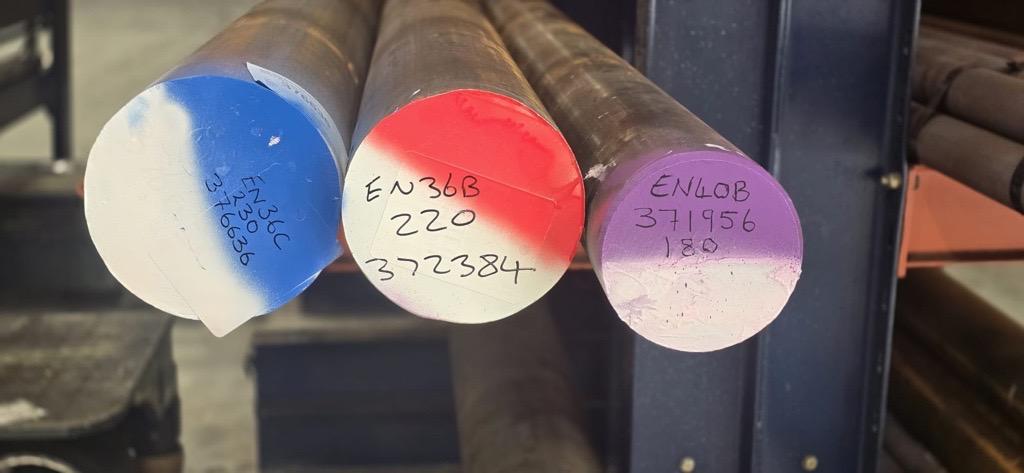
Carburising is not the only way to harden a surface. Nitriding diffuses nitrogen instead of carbon, at a much lower 500–530°C, into a steel that has already been hardened and tempered — so the part moves far less and needs no quench afterwards. It is a different grade family: EN40B (722M24) is the nitriding steel Parkside stocks, and it is not a carburising grade. The heat treatment guide sets the two routes side by side.
The consequence for grade selection: the case is a product of the process, not of the steel you bought. All five grades below finish within a few points of each other at the surface. What you are actually choosing when you pick one is the core.
The Five Grades Parkside Stocks
In ascending order of alloy content, and therefore of core strength. Compositions and properties are those published on each grade's own data page.
EN32M — 210M15
Core ~430–500 N/mm² — case 58–64 HRC0.12–0.18% carbon with no deliberate nickel, chromium or molybdenum. The economical route: it carburises readily and finishes hard at the surface, but the core stays close to mild steel. Right for lightly loaded wear parts — bushes, small pins, spacers, low-duty gears — where the job is surface durability rather than load capacity.
8620 — 805M20
Core ~620–800 N/mm² — case 58–62 HRC0.17–0.23% carbon with 0.35–0.75% nickel, 0.35–0.65% chromium and 0.15–0.25% molybdenum. The international workhorse, and the grade most often named on drawings that originate outside the UK. The modest alloy addition buys real hardenability through the section and roughly half as much core strength again as EN32M, without the cost of a 3% nickel steel.
EN36 — 655M13
Core ~930–970 N/mm² — case 58–63 HRC0.12–0.18% carbon with 3.00–3.50% nickel and 0.60–1.00% chromium. The classic British case hardening steel for transmission work. The nickel toughens the core substantially and improves its response through heavier sections, which is why it has stayed the default for gears and shafts that see shock loading.
EN36C — 832M13
Core ~1050 N/mm² — case 60–64 HRCEN36 with molybdenum added — 0.10–0.25% — and slightly more nickel at 3.00–3.75%. The molybdenum raises hardenability again and resists temper embrittlement, pushing the core past 1000 N/mm². Specified for aerospace and high-duty drivetrain gearing where EN36 is close but not quite enough.
EN39B — 835M15
Core 1000–1400 N/mm² — case up to 62–63 HRC3.80–4.30% nickel, 1.00–1.40% chromium and 0.15–0.35% molybdenum — the richest analysis of the five. The core can be taken to 1400 N/mm², which puts it in through-hardened alloy territory while still carrying a carburised case. Reserved for the most heavily loaded gearing and shafting. Stocked as black round bar only; annealed stock runs to 277 HB max.
The Core Strength Ladder
The same five grades, side by side. Read the case column first and notice how little it moves; then read the core column, which more than triples. Every figure is taken from the grade's own data page on this site.
| Grade | BS 970 | C % | Ni % | Cr % | Mo % | Core tensile N/mm² | Case HRC | Colour code |
|---|---|---|---|---|---|---|---|---|
| EN32M | 210M15 | 0.12–0.18 | — | — | — | ~430–500 | 58–64 | Black / Yellow |
| 8620 | 805M20 | 0.17–0.23 | 0.35–0.75 | 0.35–0.65 | 0.15–0.25 | ~620–800 | 58–62 | Green / Black |
| EN36 | 655M13 | 0.12–0.18 | 3.00–3.50 | 0.60–1.00 | — | ~930–970 | 58–63 | Red / White |
| EN36C | 832M13 | 0.10–0.16 | 3.00–3.75 | 0.70–1.00 | 0.10–0.25 | ~1050 | 60–64 | Blue / White |
| EN39B | 835M15 | 0.12–0.18 | 3.80–4.30 | 1.00–1.40 | 0.15–0.35 | 1000–1400 | up to 62–63 | Magenta / Blue |
Core tensile figures are after carburising, hardening and tempering, and vary with section size and the heat treatment cycle actually used. Confirm against your heat treater's procedure and your own section. Full composition with cast analysis comes on an EN 10204 3.1 certificate.
Choosing by Core, Not by Case
Because the case lands in much the same place whichever grade you start from, the selection question reduces to two things: how hard the core has to work, and how thick the section is.
The core carries little load
Bushes, spacers, small pins, low-duty gears, wear sleeves. The part needs a hard surface and nothing more from the body. EN32M is the right buy, and anything richer is money spent on properties the part will never use.
The core carries real load
Transmission gears, shafts, camshafts, splined couplings in general machinery. 8620 is the standard answer and reads straight across to drawings written in AISI. Where a UK drawing calls the same duty, EN36 is the traditional choice and gives a stronger core again.
The core must resist impact
Drivetrain gearing, heavily loaded shafts, anything with reversing or shock loads, or a section thick enough that hardenability becomes the limit. EN36, then EN36C where molybdenum is wanted for hardenability and temper resistance.
The core is the limiting factor
When the calculation says the core, not the case, will fail first. EN39B at up to 1400 N/mm² is the top of the stocked range. Remember it is black bar only, so allow machining stock.
Section size changes the answer. Core strength figures are quoted for a reference section. A plain grade that reaches its published core in a 25mm bar may not reach it in the middle of a 120mm one, because hardenability runs out. The nickel and molybdenum in the richer grades buy depth of hardening as much as peak strength — which is often the real reason to step up, independent of the headline tensile number.
Case Depth, Distortion and Machining Allowance
Three things catch people out between ordering bar and receiving a finished part.
Case depth is bought with time, not with grade. Depth is a function of how long the part is held at temperature in the carburising atmosphere. The steel affects how the case and core respond, but the depth itself is specified to the heat treater as part of the cycle. It belongs on the drawing as a requirement, not as an assumption about the material.
Machine before you carburise, finish after. The case is thin. Rough and semi-finish machining happens on the untreated bar; only grinding or honing should follow heat treatment, and the finishing allowance has to be small enough that it does not cut through the case. This is the single most common way a correctly specified part ends up with no case where it matters.
Expect movement. Heating to 880–920°C and quenching moves parts. Long, slender or asymmetric components move most. Where the finished tolerance is tight, the plan has to include a grinding operation after treatment — which is also why the finishing allowance and the case depth have to be agreed together rather than separately.
Where the bar comes in: because the surface is removed before treatment anyway, black bar with a sensible machining allowance is usually the economical buy for a carburised part. Where a ground finish is wanted on an untreated datum, precision grinding is available, and the bright bar tolerance bands set out what each supply condition holds.
Certification and Cut to Length
Parkside is a stockholder, not a heat treater. Bar leaves us in its supply condition — as rolled, annealed or bright drawn — cut to the length you need, for you or your heat treatment subcontractor to carburise once the part is close to final shape.
What matters at the ordering stage is the paperwork that follows the bar. Any heat treater quoting a carburising cycle will want the cast analysis, because the response of the steel — case depth for a given cycle, core hardness achieved, distortion behaviour — depends on where within the specification band that particular cast actually sits. An EN 10204 3.1 certificate is available on all alloy grades and should be requested when you order, not after.
Cut to length runs across thirteen saws from 10mm to 600mm diameter with a one-piece minimum, so there is no need to buy a full length to get a handful of blanks. If the designation on your drawing is written in AISI or DIN rather than BS 970, the grade equivalents table will resolve it, and the designation guide explains what each naming system encodes.
Common Questions
What engineers and buyers ask most often when specifying these grades.
Case hardening adds carbon; through hardening does not. A through-hardening steel such as EN8 or EN19 already holds enough carbon to form martensite, so heating and quenching hardens the whole section at once. The five grades on this page start at 0.10–0.23% carbon — too little to harden by quenching alone. Carburising puts carbon into the surface at around 880–920°C, so that only the outer skin responds to the subsequent quench. The result is a hard case over a core that stays comparatively soft and tough. The heat treatment guide covers both routes in detail.
EN39B (835M15), at 1000–1400 N/mm² after carburising, hardening and tempering. It carries roughly 4% nickel and 1.00–1.40% chromium — the richest analysis of the five — and is the grade specified when the core has to survive bending or impact loads that would deform a lighter steel. EN36C (832M13) follows at about 1050 N/mm², then EN36 (655M13) at 930–970. Note that EN39B is stocked as black round bar only.
No. We are a stockholder, not a heat treater. Bar leaves us in its supply condition — as rolled, annealed or bright drawn depending on the grade — cut to the length you need, for you or your heat treatment subcontractor to carburise after machining. That is the normal sequence in any case: the case is applied once the part is close to final shape, because carburising after rough machining avoids cutting through the case you have just paid for. What we do supply with it is the EN 10204 material certificate your heat treater will want before they quote.
Because the case hardness is set by the carburised surface, not by the steel underneath it. Carburising raises the surface carbon to roughly 0.8–1.0% whatever the base grade started at, and a quenched 0.8% carbon martensite lands in the high 50s to low 60s HRC regardless. That is why the five sit within a few points of one another at 58–64 HRC. The alloy content changes hardenability, case depth for a given cycle, and above all the core — which is where the five genuinely differ. Use the hardness conversion table to read HRC against HB and tensile.
No, and they sit two rungs apart. EN32M (210M15) is a plain low-carbon case hardening steel with no deliberate nickel, chromium or molybdenum; its core finishes around 430–500 N/mm². 8620 (805M20) carries 0.35–0.75% nickel, 0.35–0.65% chromium and 0.15–0.25% molybdenum, and finishes at roughly 620–800 N/mm² core with better hardenability through the section. They answer different problems: EN32M for lightly loaded wear parts, 8620 where the core has to carry real load. In AISI terms EN32M reads across to 1015/1018 and 8620 is SAE 8620 outright.
It varies by grade and is worth confirming when you order. EN39B (835M15) is stocked as black round bar only. EN36B (655M13) and EN32M (210M15) are carried in the bright round bar range. If the part is being carburised anyway, black bar with a machining allowance is often the sensible buy — you will be removing the surface before heat treatment regardless. Cut to length runs from 10mm to 600mm diameter with a one-piece minimum.