Centreless ground bright bar — tighter than h9 on diameter and a Ra 0.4–0.8 µm surface or better. Grinding is placed with a specialist; the bar, the cutting and the certificate are ours. One order, one supplier to deal with.
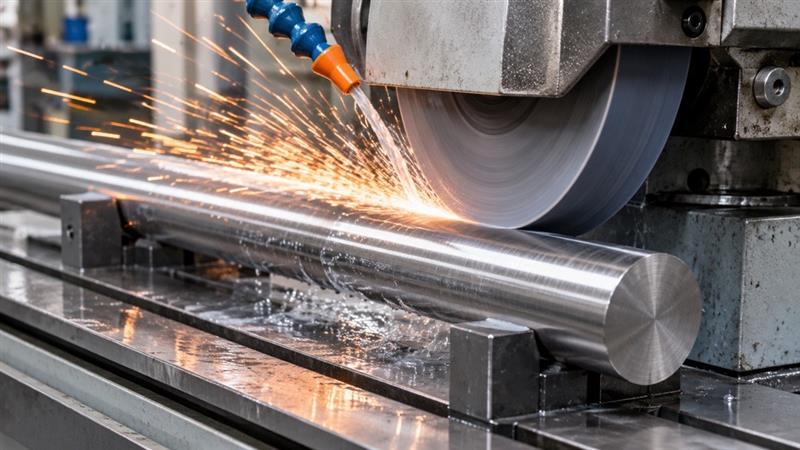
Bright drawn bar is supplied to h9, h10 or h11 under BS EN 10278, and for most turned components that is where the job starts. Centreless grinding is the step after: the bar passes between a grinding wheel and a regulating wheel, taking the diameter tighter than h9 and leaving a surface of Ra 0.4–0.8 µm or better.
You specify it when the drawing calls for a closer diameter than drawn bar holds, when the finish matters because the surface has to seal, or when the bar is used as a bearing surface with no further machining. Typical work is precision shaft journals, hydraulic piston rods and bearing locations.
The grinding itself is subcontracted to a specialist grinding house. We supply the bar from stock, place and manage the grinding, cut to length on our own site and issue the certification — so you raise one order and have one supplier to chase, but the grinding is not done under our roof and we do not claim it is.
Ground bar is available on request for selected grades and sizes. Because it is an extra operation off site, it adds to the standard lead time — tell us the grade, diameter, tolerance and finish and we will confirm what is achievable and give you a date with the quote.
Or better. This is the finish that makes a rod sealable and a journal usable without a further grinding operation at your end.
Drawn bar is h9 at smaller diameters, widening to h10 and h11 as section increases. Grinding is specified where the drawing needs closer than the drawn band allows. See the full h9 / h10 / h11 tables.
Ground bar carries the same certification options as the rest of the range, with heat-number traceability under our ISO 9001 system (FS 86692).
You send the grade, finished diameter, tolerance and finish. We check it with our grinding subcontractor and come back with what is achievable and the date, before anything is committed. Ground bar is offered on selected grades and sizes, so this step is a real check and not a formality.
Bar goes from our stock to the grinding house, where it is centreless ground to the finished diameter — passed between a grinding wheel and a regulating wheel, taking the diameter tighter than the drawn band and leaving the specified surface.
Cutting runs on the same site on 13 saws, to a standard −0 / +2mm length tolerance. Tell us whether lengths are cut before or after grinding — it changes how the job is scheduled.
EN 10204 2.2, 3.1 or 3.2 as ordered, with the heat number carried through under our ISO 9001 system. Out on our own fleet or a steel carrier, depending on where you are.
| Application | Why ground bar | Grades commonly specified |
|---|---|---|
| Hydraulic piston rods | The rod runs through a seal; surface finish decides whether the seal survives | EN19, EN24, EN40B |
| Precision shaft journals | Bearing fit depends on diameter held closer than drawn bar allows | EN8, EN19, EN24 |
| Bearing locations | Used as the bearing surface directly, with no further machining | EN8D, EN19, EN24 |
| Rod for nitriding | EN40B is stocked Q+T, ready for precision grinding and nitriding | EN40B |
Grades above are drawn from Parkside's stocked range. Ground bar is offered on request and the grinding is subcontracted, so confirm grade, diameter, tolerance and lead time with the sales team before specifying it on a drawing.
Grinding is the one operation we put out. Everything either side of it is ours: the bar comes from our own stock, the cutting runs here on 13 saws to a standard −0 / +2mm length tolerance, and the EN 10204 certificate and heat number come from us under our ISO 9001 system.
That matters practically — you place one order, chase one supplier, and get one certificate covering the material you actually received. There is no minimum order. One piece gets the same handling as a full bar.
Grinding is quoted per job, so the quote is only as good as the specification. Have these to hand:
Grade and condition — e.g. EN19 in the T condition.
Finished diameter and tolerance — the number on the drawing, not the nominal.
Surface finish required — in Ra, if the drawing states one.
Length and quantity — and whether lengths are cut before or after grinding.
Certification — EN 10204 2.2, 3.1 or 3.2.