Grade Designations.
| BS EN 10084:2008 | 15NiCrMo16-5 / 1.6723 |
| BS 970:1991 (withdrawn) | 835M15 |
| BS 970:1955 | EN39B |
| DIN | 15NiCrMo16-5 / 1.6723 |
| Material class | ~4.5% Ni-Cr-Mo case hardening |
Grade-equivalence naming varies by supplier and is conventional rather than an exact chemistry match — confirm against your EN 10204 certificate where precise cross-referencing matters.
Availability & Supply Condition.
Black Rounds: 40–300mm
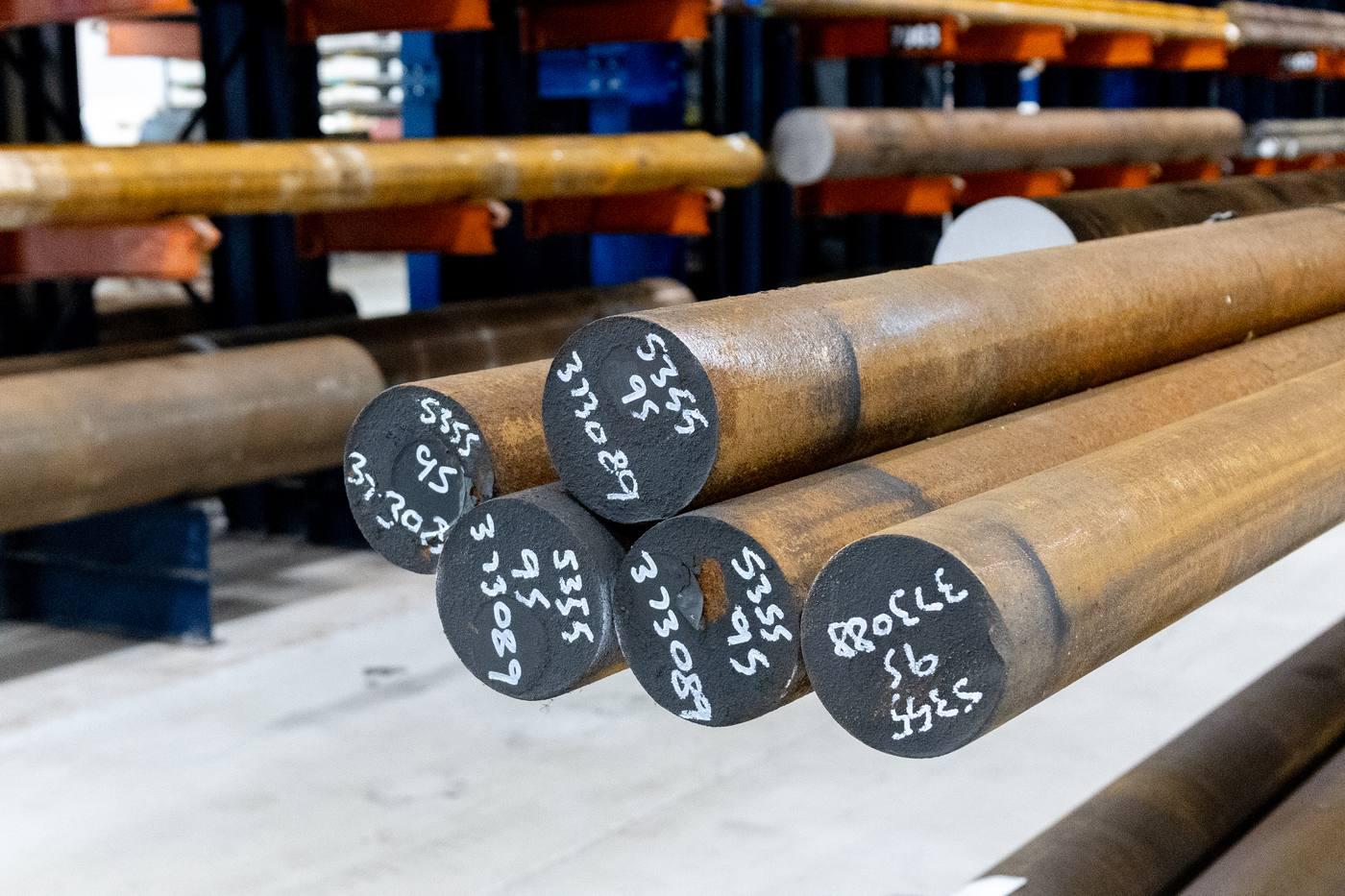
Supply condition: Hot Rolled Black, typically supplied as rolled or annealed (277 HB max annealed). Black bar only — this grade is not stocked as bright bar.
Cut to length from 1 piece — −0/+2mm standard tolerance — 2–3 day turnaround — Cutting service details ›
Chemical Analysis.
Values shown as percentages by weight (% wt). Values are ranges unless stated as maxima.
| Designation | C | Si | Mn | P max | S max | Cr | Ni | Mo |
|---|---|---|---|---|---|---|---|---|
| 835M15 | 0.12–0.18 | 0.10–0.35 | 0.25–0.50 | 0.035 | 0.040 | 1.00–1.40 | 3.90–4.30 | 0.15–0.30 |
For full chemical analysis with heat number, request an EN 10204 3.1 material test certificate when ordering — available on all alloy grades. Certificate types explained ›
Each alloying element does a specific job: the ~4% nickel gives the core its toughness and shock resistance; chromium adds hardenability and supports case wear resistance; molybdenum carries hardenability deeper into large sections and helps the core develop uniform properties.
Mechanical Properties.
Values shown for standard supply condition and after case hardening. Properties vary by section size, case depth and heat treatment condition.
| Condition | Core Tensile (N/mm²) | Case HRC | Hardness HB |
|---|---|---|---|
| Annealed | — | — | 277 max |
| After carburise, harden & temper | 1000–1400 | up to 62–63 | — |
Hardness values: see our hardness conversion table to convert between HRC, HB, HV and tensile strength.
As Rolled or Annealed.
EN39B is normally supplied either as rolled or annealed. Both describe the state the bar arrives in before you machine it, and the difference shows up at the spindle rather than on the certificate.
Bar in the condition it left the hot rolling mill, with no softening treatment afterwards. Its hardness is whatever the rolling and the cooling that followed happened to leave behind, so it can sit higher — and vary more from bar to bar — than annealed material.
The bar is reheated, held at temperature, then cooled slowly — usually in the furnace itself. That slow cool lets the structure soften and even out, giving lower and more consistent hardness while relieving the stresses rolling left in the bar. It is the softest, most machinable condition this grade comes in, which is where the 277 HB maximum quoted above applies.
For a grade like this the distinction matters twice over. First, all the machining happens before any hardening — annealed bar cuts more easily and is kinder to tooling. Second, a bar with rolling stresses still in it is more likely to move as metal comes off, which shows up as parts drifting out of tolerance on long or asymmetric components. If you are taking heavy cuts or holding tight tolerances, specify annealed on the order rather than assuming it, and check the condition stated on your EN 10204 certificate. Either way, the real hardening happens after machining — carburise, harden and temper.
Typical Applications.
- High-duty gears and heavy-duty worms
- Heavy roller bearings
- Camshafts and valve rockers
- Breech mechanisms and small arms components
- Clutch plates and flywheels
Key Benefits.
- Case hardness up to 62–63 HRC after carburising
- Core tensile 1000–1400 N/mm² after heat treatment
- ~4% nickel gives exceptional core toughness under shock loading
- Molybdenum supports uniform hardening in large cross-sections
- Available annealed to 277 HB max where machinability matters
- Available cut to length from one piece — no minimum order
Remarks & Guidance.
Supplied as rolled or annealed — machine first, then carburise, harden and temper. Where the full ~4.5% nickel specification is not required, EN36 (655M13) or 8620 (805M20) are more economical case hardening choices; EN36C (832M13) sits alongside this grade at the top of the range. As with all high-alloy case hardening steels, welding is not recommended.
Relevant Heat Treatment Processes.
This grade responds to the following heat treatment processes. Click any card for temperatures, cooling methods and expected hardness values.