Why the Mill Minimum Exists
A rolling mill is built to run long. Every change of grade, section or size means re-setting rolls, reheating to the right temperature and running scrap material until the dimensions settle — so each production run carries a large fixed cost that only makes sense when it is spread across a lot of tonnes. That is why mills quote a minimum order quantity rather than a per-piece price, and why the minimum is not small.
As a rough guide, a plain carbon engineering steel typically needs an order in the region of 10 to 25 tonnes to go on a mill's rolling schedule, and an alloy grade more like 25 to 50 tonnes. Below that, the setup cost per tonne climbs until the price stops being competitive and the mill simply declines the work. The minimum is not the mill being awkward; it is the economics of the process.
Lead time follows the same logic. A mill order does not start when you place it — it starts when your grade and size come up on the rolling schedule, which is set to batch similar products together and moves for reasons that have nothing to do with your job. From the point an order enters the schedule, six to twelve weeks to delivery is a normal range once you add rolling, cooling and straightening, testing and sampling, and the paperwork for the mill certificate.
What a Mill Order Really Ties Up
The headline price per tonne from a mill will usually look good next to a stockholder's price per metre — that is the comparison most buyers make first, and on its own it is misleading. The real cost of a mill order is everything that comes with the tonnage you did not need.
- Working capital. If the job needs 400 kg and the minimum is 10 tonnes, the other 9.6 tonnes is cash converted into steel sitting on a rack. That capital cannot fund anything else until the surplus is used — and for an alloy grade bought for one contract, that can be years, or never.
- Storage and handling. Full-length bar has to be racked, moved and kept traceable. Floor space, cranage and stock control are real costs that scale with how much surplus you hold.
- Drop and offcut. Bar comes in mill lengths. Every time you cut a job from a full length you create an end that may be too short for the next job, and that drop is paid-for steel you may never recover value from.
- Lead-time risk. A six-to-twelve-week mill lead time has to be committed to before you know how a contract will run. If the job changes, the specification moves, or the order is cancelled, the steel is already rolling.
- Grade risk. Over-ordering pushes buyers toward holding one "safe" high grade for everything, which means paying alloy prices for work that a cheaper grade would have done.
None of this argues that mills are the wrong place to make steel — they are the only place. It argues that buying direct from one, in mill quantities, is the wrong shape for most machining and fabrication work, where jobs are measured in kilos and metres rather than tonnes.
What Cut-to-Length From Stock Changes
A stockholder has already done the part that carries the minimum: bought the full mill run, taken it into stock, and absorbed the working capital and the storage. What you then buy is the quantity the job needs, cut to the length you specify, from a grade that is already sitting on the shelf.
That changes the arithmetic in five places, which line up directly against the five costs above.
| Factor | Direct from the mill | Cut-to-length from stock |
|---|---|---|
| Minimum order | ~10–25 t carbon, ~25–50 t alloy, per line item | From a single cut piece; no tonnage minimum |
| Lead time | Typically 6–12 weeks once on the rolling schedule | Off the shelf; next-day on most stocked lines |
| Working capital | Pay for the whole run up front; surplus sits as stock | Pay for the metres you use |
| Offcut & drop | Yours to store, use or scrap | Stays with the stockholder |
| Grade flexibility | One grade/size per minimum run | Mix grades and sizes freely across one order |
| Certification | Mill certificate with the cast | EN 10204 cert carried through from the same cast |
The point the table makes is that cut-to-length is not simply "a bit more expensive per kilo." It moves the whole cost of holding steel — the capital, the space, the drop, the lead-time gamble — off your balance sheet and onto the stockholder's, where a business built for it carries it most efficiently. You pay for certainty and flexibility in the per-metre price rather than in cash tied up on a rack.
Why This Comparison Has Shifted in 2026
The stock-versus-mill trade-off is not new, but two things have pushed it further toward stock this year, and both affect any buyer importing or over-ordering to beat a minimum.
First, the UK's steel import regime tightened sharply from 1 July 2026, when the duty-free tariff-rate quotas were cut by around half and a 50% tariff applied to imports above the quota. Several country quotas have run out well before the quota year is over, which makes a large speculative import order a genuine gamble on whether it clears duty-free at all. Second, mill prices have kept climbing — UK fabricated structural steel prices rose 21.2% in the year to August 2026, European mills have continued to announce list-price increases, and the UK steel industry is openly expecting higher prices again in 2027 as the UK carbon border adjustment mechanism starts on 1 January 2027.
Put together, those two trends raise the cost of the surplus a mill minimum forces you to carry. Steel bought ahead of need is now more expensive to buy, more exposed to a quota running out mid-year, and more likely to be worth less than you hope if prices do not move your way. Holding less, closer to the job, is the lower-risk position in a rising and supply-constrained market — which is exactly what buying cut-to-length from domestic stock lets you do.
When a Mill Order Still Makes Sense
Stock is not always the answer, and it is worth being honest about where going direct wins. A mill order earns its place when:
- The volume is genuinely high and repeatable. A production line consuming tonnes of one grade and size every week can clear a minimum easily, and the per-tonne mill price then wins on a cost it can actually absorb.
- The grade or size is not a stock item. A non-standard section, an unusual grade, or a diameter outside the normal stock range may only be available on a mill run — though a stockholder will often know who rolls it and can place that order for you.
- You need a specific cast or special test regime that only a dedicated heat will satisfy.
The deciding question is not "which is cheaper per tonne," it is "will I use the whole run before it costs me more to hold than it saved to buy." For high-volume repeat production the answer is often yes. For the mixed, variable, cut-to-size work that fills most machine shops and fabrication bays, it is almost always no — and that is the work stock exists to serve.
Not sure whether your job clears a mill minimum, or is better off the shelf? Send us the grade, diameter and quantity and we will tell you straight.
► Request a QuoteHow Parkside Fits
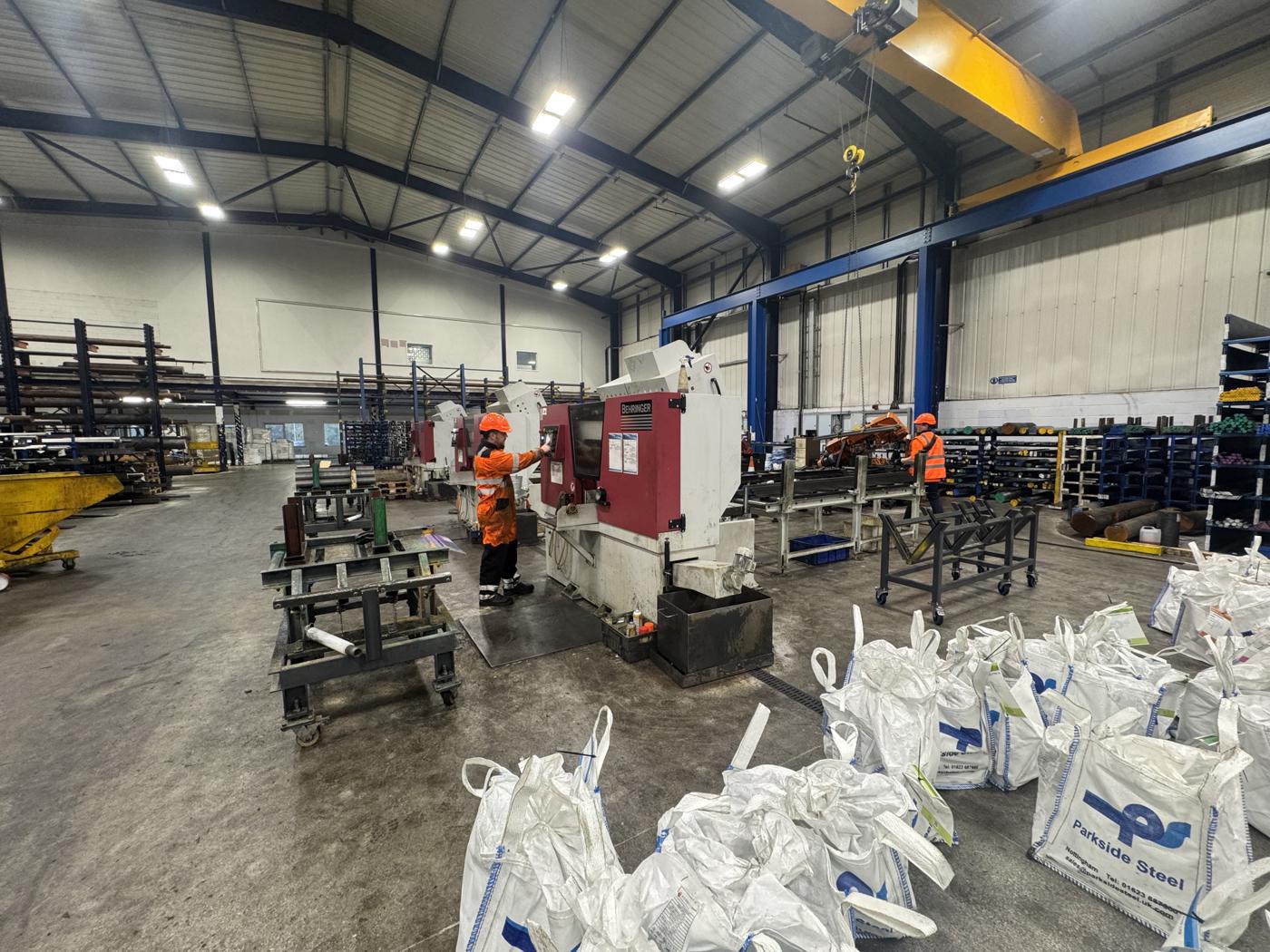
This is the business Parkside has run since 1977: carrying the engineering steel bar that machine shops and fabricators use most, so the minimum has already been cleared by the time you call. We hold the common free-cutting and through-hardening grades — EN1A (230M07), EN8 (080M40), EN19 (708M40) and EN24 (817M40) among them — in bright and black bar, and we cut to length across 13 saws from 10 mm to 600 mm diameter. You buy the metres the job needs rather than a mill's tonnage, every consignment carries EN 10204 material certification with full heat traceability, and it moves on our own fleet with next-day delivery nationwide. If a grade is outside what we stock, our sales desk will tell you plainly and, where a mill run really is the right route, point you at it rather than sell you the wrong thing.
If you are not sure which grade the job actually needs before you price it, our grade equivalents table is a good place to start, and the industries we supply — from CNC machining and hydraulics to automotive and oil & gas — are exactly the mixed-volume, cut-to-size customers this way of buying is built for.
What to Check Before You Order
- Work out the real quantity. Add up what the job needs in metres or kilos, including sensible cutting allowance — not what a minimum forces you to buy. That number decides which route fits.
- Compare total cost, not price per tonne. Put the mill's tonne price next to the stockholder's metre price for the quantity you will actually use, and add in storage, drop and the cash tied up in surplus.
- Check the lead time against the job. If the work starts in weeks, a six-to-twelve-week mill run is not a candidate — stock is the only route that meets the date.
- Match the grade to the duty. Do not default to a high alloy grade to cover everything; buy the grade the part needs, which is easy when you are not clearing a minimum on each one.
- Confirm certification travels with the cut. Ask for EN 10204 certification on the cut material so the cast is traceable, exactly as it would be on a full length.
Our View
Buying direct from a mill is the right move for a narrow set of jobs: high volume, one grade, one size, a date you can wait for. For almost everything else — the mixed, cut-to-size, plan-as-you-go work that keeps a machine shop busy — the mill minimum is a cost dressed up as a saving. It forces you to buy steel you do not need, store it, and carry the risk that it loses value before you use it, all to beat a per-tonne price on tonnes you never wanted.
A stockholder's job is to absorb that for you, and in a year of tighter quotas and climbing prices, holding less and buying closer to the job is the lower-risk way to work. If you want to sense-check a buy, that is a two-minute conversation our sales desk has every day.
Speak to the Parkside Team
Our sales team is on the phone Mon-Fri 08:00-17:00. No minimum order. Next-day available on most lines.