Why the Drawing Says 4140 and the Stock List Says EN19
Engineering steels carry several names at once. The same bar is EN19 in the old British En series, 708M40 in BS 970, 42CrMo4 in the European system, 1.7225 as a Werkstoff number and AISI 4140 in American practice. None of them is more correct than the others; they are different catalogues of the same material.
Which one appears on a drawing is largely a matter of where the drawing was written and who the end client is. Oil and gas, downhole tooling, defence and export machining work overwhelmingly use AISI and SAE numbers, because that is the convention of the specifications those sectors are built on. A UK machine shop then has to translate before it can buy.
For the two most commonly specified alloy steels, the translation is short, and both are stock items here.
The two that matter: AISI 4140 is EN19 (708M40). AISI 4340 is EN24 (817M40). Everything below is the evidence for those two sentences, plus an honest account of where the stock range stops.
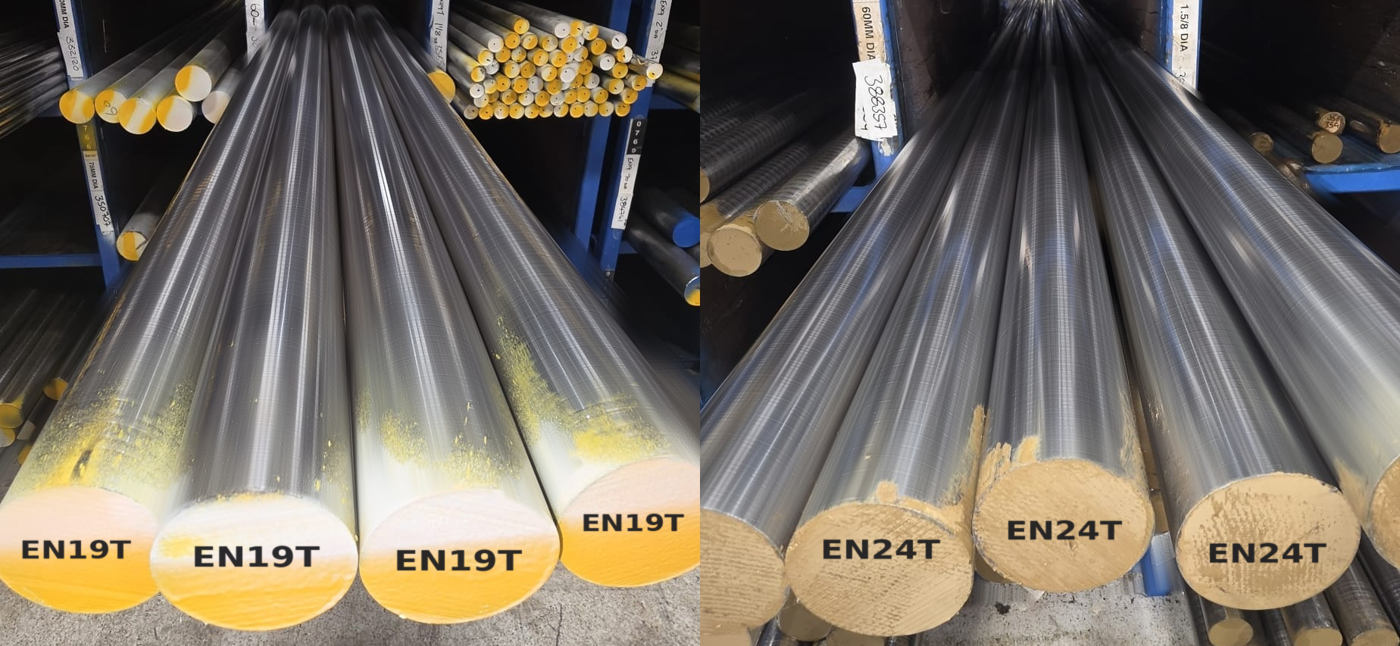
AISI 4140 — Order EN19
A 0.40% carbon chromium-molybdenum steel, hardened and tempered. It is the general-purpose high-tensile alloy of the engineering world: shafts, spindles, couplings, tooling bodies, hydraulic components, downhole subs and crossovers.
EN19 — 708M40
0.36–0.44% C · 0.90–1.20% Cr · 0.15–0.25% MoAlso 42CrMo4 and Werkstoff 1.7225. Supplied hardened and tempered in condition T: 1000–1200 N/mm² up to 16mm, easing to 750–950 N/mm² between 63 and 100mm, at roughly 295–350 HB.
EN19 — 709M40
Identical, except 0.25–0.35% MoThe only difference from 708M40 is the molybdenum range. Published mechanical properties are the same. The extra molybdenum helps hardenability in heavier sections and resistance to temper embrittlement, which is why some specifications name it explicitly.
AISI 4340 — Order EN24
Add nickel to 4140 and you get 4340: a nickel-chromium-molybdenum steel with better hardenability and markedly better toughness at strength. It is the grade specified when a part is both highly stressed and too thick for 4140 to harden through — landing gear components, heavy shafting, drive couplings, high-integrity downhole tooling.
EN24 — 817M40
0.36–0.44% C · 1.00–1.40% Cr · 1.30–1.70% Ni · 0.20–0.35% MoAlso 34CrNiMo6 and Werkstoff 1.6582. Condition T gives 1150 N/mm² up to 16mm, 1000 N/mm² to 40mm, 900 N/mm² to 63mm and 800 N/mm² to 100mm, at roughly 300–341 HB. Normalised stock runs about 860 N/mm².
EN26 — 826M40
2.30–2.80% Ni · 0.45–0.65% MoNot a 4340 substitute — a richer steel again, for sections heavy enough that EN24 will not harden through, or tensile requirements above what EN24 reaches at that size. Supplied to BS 970 conditions, normally V and W. Black bar only.
Composition, Side by Side
Every figure below is the composition Parkside publishes for the stocked grade, set against the AISI and European designations the same steel answers to. This is the read-across behind the two matches above.
| AISI / SAE | BS 970 | Formerly | European | Werkstoff | C % | Cr % | Ni % | Mo % |
|---|---|---|---|---|---|---|---|---|
| 4135 | 605M36 | EN16 | 34CrMo4 | 1.7220 | 0.30–0.40 | 0.90–1.20 | — | 0.25–0.35 |
| 4140 | 708M40 | EN19 | 42CrMo4 | 1.7225 | 0.36–0.44 | 0.90–1.20 | — | 0.15–0.25 |
| 4140 | 709M40 | EN19 | 42CrMo4 | 1.7225 | 0.36–0.44 | 0.90–1.20 | — | 0.25–0.35 |
| 4340 | 817M40 | EN24 | 34CrNiMo6 | 1.6582 | 0.36–0.44 | 1.00–1.40 | 1.30–1.70 | 0.20–0.35 |
| — | 826M40 | EN26 | 40NiCrMo10-5 | 1.6745 | 0.36–0.44 | 0.50–0.80 | 2.30–2.80 | 0.45–0.65 |
Equivalences are near-equivalences. Where a specification is contractual, verify against the cast analysis on the EN 10204 3.1 certificate rather than the grade name. The full cross-reference across BS, EN, DIN and AISI for all 26 stocked grades is in the grade equivalents table.
4130, 4145 and 4330V — What We Do Not Hold
Oil and gas specifications routinely name AISI grades beyond 4140 and 4340. Parkside does not stock an equivalent for all of them, and it is more useful to say so than to offer a near-miss.
4130. Not stocked. The nearest grade in the range is EN16 (605M36 / 34CrMo4), which cross-references to AISI 4135 — a carbon step below 4140 at 0.30–0.40%, with the same chromium band. It is not 4130 and must not be certified as 4130. Where a drawing calls 4130 for lower-carbon weldability, EN16 is worth a conversation, but substituting it is a decision for the design authority.
4145 and 4330V. Not stocked, and no close equivalent in the range. 4145 is a higher-carbon 4140 derivative used for drill collars and heavy downhole components; 4330V is a vanadium-modified nickel-chromium-molybdenum grade written into specific energy-sector specifications. Neither reads across to a BS 970 grade we carry.
Why this matters more than a sale: substituting one alloy steel for another on a part destined for a pressure-containing or safety-critical assembly is a specification decision with consequences, and it is not a stockholder's to make. If 4140 or 4340 is what the drawing says, the bar is here. If it says something else, we would rather tell you plainly than supply the nearest thing and leave the question open.
Certification and Traceability
Buying a UK grade against an American designation puts the weight on the paperwork. The grade name establishes the intent; the certificate establishes what actually arrived.
An EN 10204 3.1 certificate is available on all alloy grades and reports the cast analysis and mechanical test results for the specific cast supplied. That document is what lets a machine shop show its customer that the EN19 it bought meets the 4140 the drawing called for — element by element, against the specification, rather than by assertion. For energy, defence and aerospace work it is usually a condition of supply rather than an option.
Parkside has traded since 1977 and is ISO 9001 certified under FS 86692. Accreditations and certification sets out what each certificate type covers, and how to read a mill certificate walks through an actual document field by field. Cut to length covers 10mm to 600mm diameter with a one-piece minimum, and the industries page sets out the sectors we supply.
Common Questions
What engineers and buyers ask most often when specifying these grades.
Near-equivalent, not identical, and the designations show why. AISI 4140 and BS 970's 708M40 are both nominally 0.40% carbon chromium-molybdenum steels and are used interchangeably across the great majority of applications. The published ranges differ slightly at the edges — 708M40 is 0.36–0.44% C with 0.90–1.20% Cr and 0.15–0.25% Mo, while the European 42CrMo4 runs 0.38–0.45% C with 0.15–0.30% Mo. For most work that difference is immaterial. Where a specification is contractual, read the actual cast analysis on the certificate rather than relying on the equivalence.
EN24 (817M40). That is the direct read-across: 1.30–1.70% nickel, 1.00–1.40% chromium, 0.20–0.35% molybdenum at 0.40% carbon. EN26 (826M40) is a step up again — 2.30–2.80% nickel and 0.45–0.65% molybdenum — and is the grade to consider when the section is heavy enough that EN24 will not harden through, or when the required tensile sits above what EN24 delivers at that size. EN26 is not an AISI 4340 substitute on a certificate; it is a different, richer steel.
Molybdenum, and nothing else. 708M40 carries 0.15–0.25% Mo; 709M40 carries 0.25–0.35%. Carbon, chromium, manganese and silicon ranges are the same, and the published mechanical properties are identical. The higher molybdenum improves hardenability in heavier sections and resistance to temper embrittlement. Both answer AISI 4140. If your drawing simply says EN19 or 4140, either is appropriate; if it names 709M40 specifically, order that.
Not 4130 itself. The nearest stocked grade is EN16 (605M36 / 34CrMo4), which cross-references to AISI 4135 — one carbon step below 4140 at 0.30–0.40% C with 0.90–1.20% Cr. It is not 4130, and should not be supplied or certified as 4130. Where a drawing calls 4130 for weldability at lower carbon, EN16 is worth discussing but is a substitution decision for the design authority to make, not a drop-in. We do not hold a 4145 or 4330V equivalent at all.
An EN 10204 3.1 material test certificate is available on all alloy grades, including EN16, EN19, EN24 and EN26, and gives the cast analysis and mechanical test results for the specific cast supplied. That is the document that lets you demonstrate the UK grade you received meets the AISI specification your drawing calls for — which is exactly the evidence an oil and gas or defence customer will ask for. Parkside is ISO 9001 certified, FS 86692. See accreditations and certification, or the guide to reading a mill certificate.