Grade Designations.
| BS 970:1955 | EN26 |
| BS 970:1991 (withdrawn) | 826M40 |
| BS EN | 40NiMoCr10-5 |
| Werkstoff No. | 1.6745 |
| AISI/SAE | — |
Grade-equivalence naming varies by supplier and is conventional rather than an exact chemistry match — confirm against your EN 10204 certificate where precise cross-referencing matters.
Availability & Supply Condition.
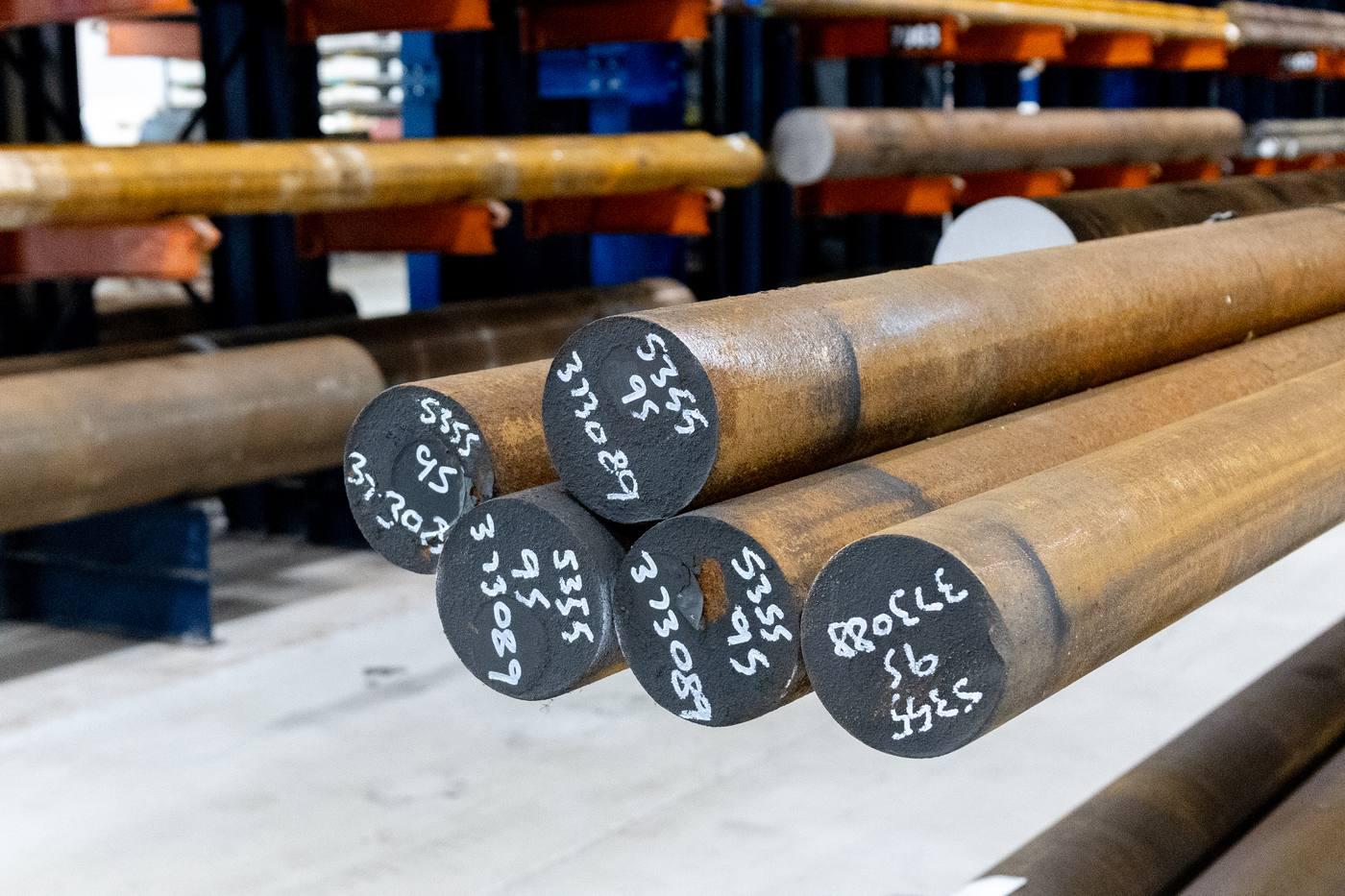
Black Rounds: 40–300mm
Supply condition: Hot Rolled Black, supplied hardened and tempered. Conditions V and W are the most commonly specified — V at 1000–1150 N/mm² and W at 1075–1225 N/mm². Other BS 970 conditions can be sourced on request. Black bar only — this grade is not stocked as bright bar.
Cut to length from 1 piece — −0/+2mm standard tolerance — 2–3 day turnaround — Cutting service details ›
Chemical Analysis.
Values shown as percentages by weight (% wt). Values are ranges unless stated as maxima.
| Designation | C | Si | Mn | P max | S max | Cr | Ni | Mo |
|---|---|---|---|---|---|---|---|---|
| 826M40 | 0.36–0.44 | 0.10–0.35 | 0.45–0.70 | 0.035 | 0.040 | 0.50–0.80 | 2.30–2.80 | 0.45–0.65 |
For full chemical analysis with heat number, request an EN 10204 3.1 material test certificate when ordering — available on all alloy grades. Certificate types explained ›
Each alloying element does a specific job here: the ~2.5% nickel gives toughness and deep hardenability; chromium adds hardenability and wear resistance; and the relatively high molybdenum — 0.45–0.65%, well above EN24 — is what suppresses temper brittleness, so the grade can be tempered anywhere in the 300–550°C range without the collapse in impact toughness that band causes in leaner alloy steels.
Mechanical Properties.
826M40 is supplied and specified against the BS 970 heat-treatment conditions. Conditions V and W are the most commonly specified and are what we normally supply; the remaining conditions can be sourced on request. Properties are limiting ruling section values — confirm against your section size.
| Condition | Tensile Rm (N/mm²) | Yield Re min (N/mm²) | Elongation A% min | Hardness HB |
|---|---|---|---|---|
| U | 925–1075 | 755 | 12 | 269–331 |
| V — common | 1000–1150 | 850 | 12 | 293–352 |
| W — common | 1075–1225 | 940 | 11 | 311–375 |
| X | 1150–1300 | 1020 | 10 | 341–401 |
| Y | 1225–1375 | 1095 | 10 | 363–429 |
| Z | 1550 max | 1235 | 5 | 444 max |
Hardness values: see our hardness conversion table to convert between HRC, HB, HV and tensile strength.
What the Conditions Mean.
BS 970 does not describe 826M40 by a single set of properties. It defines a ladder of heat-treatment conditions, U through Z, each a tighter tensile band reached by tempering the hardened bar at a progressively lower temperature. The letter on your drawing is what fixes the mechanical properties, not the grade name on its own.
All the conditions start from the same bar and the same hardening operation. What separates them is the tempering temperature afterwards: temper high and you land in U, temper low and you climb toward Z. Strength rises as you go up the ladder and ductility falls with it — elongation drops from 12% at U to 5% at Z. Choosing a condition is choosing where on that trade-off the part needs to sit.
Between them, Condition V (1000–1150 N/mm², 850 min yield) and Condition W (1075–1225 N/mm², 940 min yield) cover the majority of high-tensile shaft, gear and fastener work. Both keep elongation at 11–12% and still machine and drill reasonably, which is why they are the two letters most drawings call for. Either arrives ready to use — no hardening operation to schedule and no distortion to design around. Where a drawing calls for a different letter, we can source it.
Two things worth flagging. First, these are limiting ruling section figures — the values hold up to a stated section size, and a bar thicker than that will not reach them at the centre. Deep hardenability is exactly what 826M40 is for, but the limit still exists, so check the ruling section against your diameter. Second, if the part is to be nitrided, induction or flame hardened later, that happens after machining and does not replace the through-hardened condition underneath — the core properties still come from the letter you specify here.
Typical Applications.
- Aircraft undercarriage components and airframe parts
- Ordnance components and turbine discs
- Heavy-duty transmission gears and pinions
- Connecting rods, crankshafts and differential shafts
- High-strength studs and bolts
- Electric motor shafts
- Mandrel bars for seamless tube manufacture
- High-stress press and die holders
Key Benefits.
- Higher tensile and fatigue strength than standard EN24
- Deep hardenability — large sections hold properties from surface to core
- High molybdenum resists temper brittleness across 300–550°C
- Supplied ready-treated in Condition V or W — no hardening to schedule
- Suitable for nitriding, induction and flame hardening after machining
- Full BS 970 condition ladder U to Z available to order
Remarks & Guidance.
Supplied hardened and tempered — usually Condition V or W — so the bar arrives at its working strength — machine it as supplied rather than treating it afterwards. Where a part needs a harder surface than the through-hardened core provides, 826M40 takes nitriding well and can also be induction or flame hardened; all of that happens after machining. Keep tempering above 300°C if the part is ever re-treated — the molybdenum content is there precisely so the 300–550°C band can be used safely, which is not true of leaner alloy steels. Where the full 2.5% nickel specification is not required, EN24 (817M40) is the more economical high-tensile choice; where even deeper hardenability is needed in very heavy sections, EN30B (835M30) carries roughly 4% nickel. Welding is not recommended on this grade in the hardened and tempered condition.
Relevant Heat Treatment Processes.
This grade responds to the following heat treatment processes. Click any card for temperatures, cooling methods and expected hardness values.
Austenitise at 820–850°C and quench in oil. Deep hardenability lets heavy sections harden through.
Tempering temperature sets the BS 970 condition. The 300–550°C band is usable here — the molybdenum suppresses temper brittleness.
826M40 is fully suitable for nitriding after machining. For a dedicated nitriding grade see EN40B (722M24).
Temper after hardening to set the final tensile range — low for tooling hardness, higher for ductility.