Grade Designations.
| BS EN 10083-3:2006 | 42CrMo4 / 1.7225 |
| BS 970:1991 (withdrawn) | 709M40 / 708M40 |
| AISI/SAE | 4140 / 4142 |
| DIN | 42CrMo4 / 1.7225 |
| JIS | SCM440 |
709M40 is the higher-molybdenum EN19 variant. Its sister grade 708M40 (0.15–0.25% Mo) is otherwise identical — see 708M40 vs 709M40 for a full side-by-side.
Availability & Supply Condition.
Bright Rounds: 8–100mm | Black Rounds: 25–500mm | T-condition (Q+T): 25–150mm selected sizes
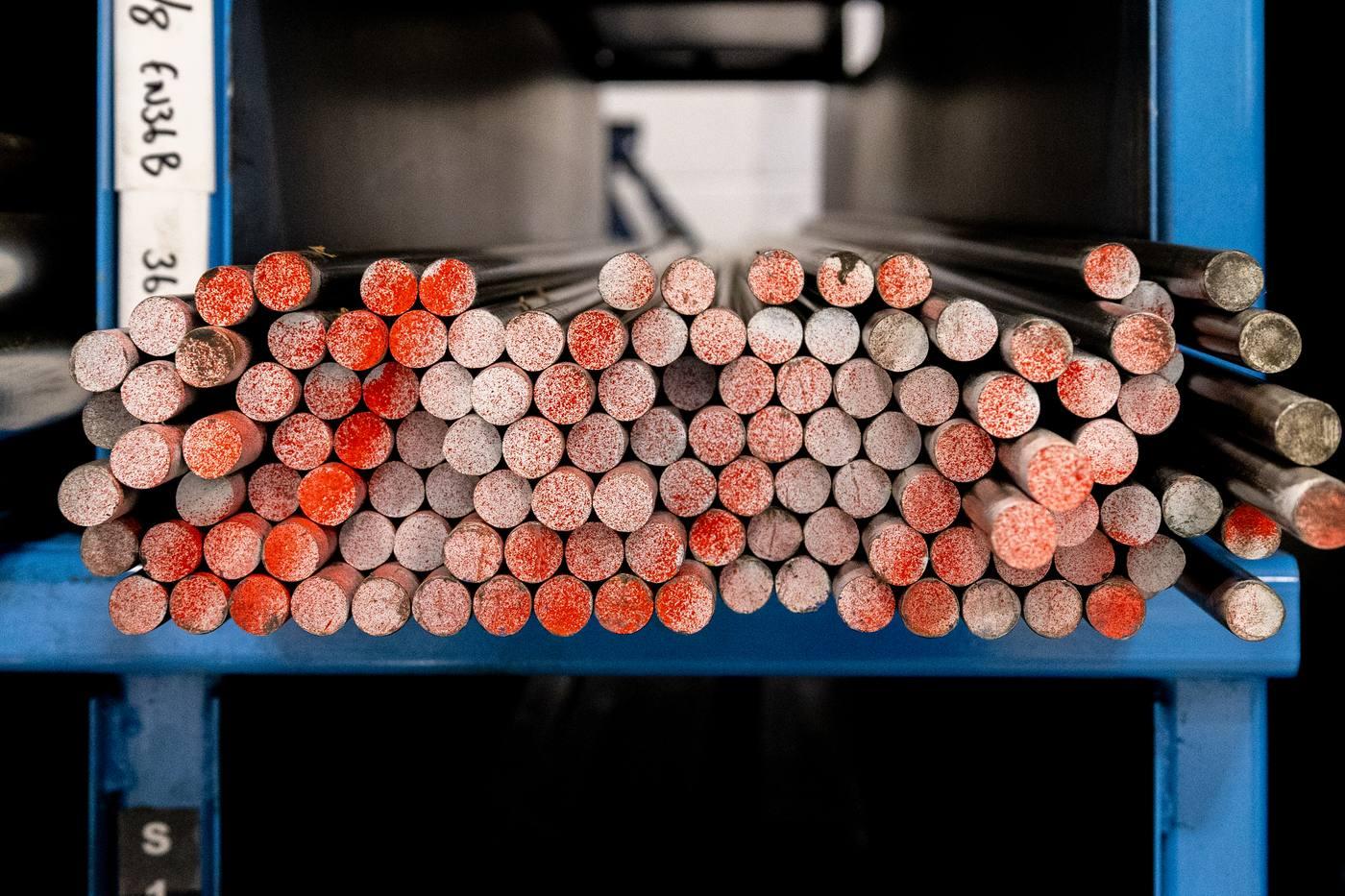
Supply condition: Bright Drawn, Hot Rolled Black, or Quenched & Tempered (T condition). Normalised or annealed also available.
Cut to length from 1 piece — −0/+2mm standard tolerance — 2–3 day turnaround — Cutting service details ›
Chemical Analysis.
Values shown as percentages by weight (% wt). Values are ranges unless stated as maxima. The only difference from 708M40 is molybdenum (708M40 = 0.15–0.25%).
| Designation | C | Si | Mn | P max | S max | Cr | Mo |
|---|---|---|---|---|---|---|---|
| 709M40 | 0.36–0.44 | 0.10–0.35 | 0.70–1.00 | 0.035 | 0.040 | 0.90–1.20 | 0.25–0.35 |
| 42CrMo4 | 0.38–0.45 | 0.17–0.37 | 0.60–0.90 | 0.035 | 0.035 | 0.90–1.20 | 0.15–0.30 |
For full chemical analysis with heat number, request an EN 10204 3.1 material test certificate when ordering — available on all alloy grades. Certificate types explained ›
Mechanical Properties.
Identical to 708M40. Values shown for standard supply condition; properties vary by section size and heat treatment condition.
| Condition | Size (mm) | Tensile Rm (N/mm²) | Yield Re (N/mm²) | A% min | HB approx |
|---|---|---|---|---|---|
| H&T (T) | ≤16 / >16–40 / >40–63 / >63–100 | 1000–1200 / 900–1100 / 800–1000 / 750–950 | ≥800 / ≥650 / ≥550 / ≥500 | 10 / 11 / 12 / 13 | 295–350 |
| Normalised | All | ~850 | ~550 | ~14 | ~248 |
Hardness values: see our hardness conversion table to convert between HRC, HB, HV and tensile strength.
Typical Applications.
- Larger-section high-tensile shafts and axles
- Gears, pinions and spindles in heavier duty
- Crankshafts and connecting rods
- High-tensile bolts and studs
- Oil and gas drilling components
- Automotive driveline and transmission
- Heavy hydraulic and pneumatic cylinders
Key Benefits.
- Higher molybdenum (0.25–0.35%) for deeper hardenability
- Better through-hardening in larger sections than 708M40
- High tensile and yield strength after Q+T
- Good wear resistance and fatigue strength
- No nickel content — more cost-effective than EN24
- Recognised globally as 42CrMo4 / AISI 4140
Remarks & Guidance.
Preheat to 200–300°C before welding. Post-weld stress relief at 600–650°C strongly recommended for stressed components. Avoid welding in T (Q+T) condition without specialist procedure. Hardening: oil quench from 840–870°C. Tempering: 550–660°C to achieve required tensile range. The higher molybdenum content makes 709M40 the better choice over 708M40 where full through-hardening is needed in sections above roughly 65mm.
Relevant Heat Treatment Processes.
This grade responds to the following heat treatment processes. Click any card for temperatures, cooling methods and expected hardness values.
Normalising refines grain structure and relieves stress after forging or machining.
This grade responds to quench hardening — oil quench from austenitising temperature.
Temper after hardening to achieve the required tensile range and reduce brittleness.