Grade Designations.
| BS 970:1955 | EN31 |
| BS 970:1991 (withdrawn) | 535A99 |
| BS EN ISO 683-17 | 100Cr6 |
| Werkstoff No. | 1.3505 |
| AISI/SAE | AISI 52100 (ASTM A295) |
Grade-equivalence naming varies by supplier and is conventional rather than an exact chemistry match — confirm against your EN 10204 certificate where precise cross-referencing matters.
Availability & Supply Condition.
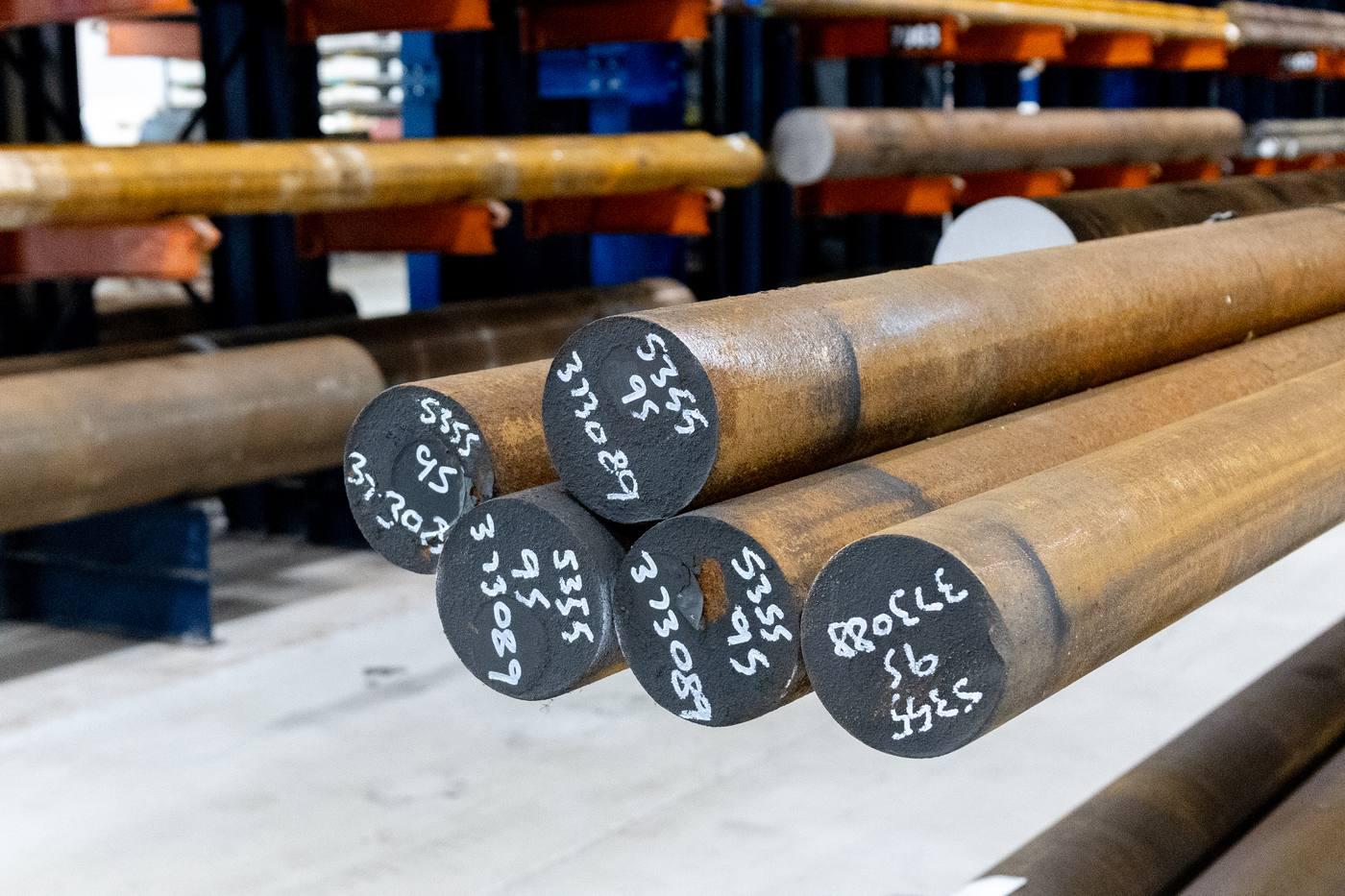
Black Rounds: 60–200mm
Supply condition: Hot Rolled Black, supplied spheroidised annealed — typically around 210 HB, 250 HB maximum — so the bar can be machined before hardening. Black bar only — this grade is not stocked as bright bar. Conditions V and W are the most commonly specified — V at 1000–1150 N/mm² and W at 1075–1225 N/mm². Other BS 970 conditions can be sourced on request. Black bar only — this grade is not stocked as bright bar.
Cut to length from 1 piece — −0/+2mm standard tolerance — 2–3 day turnaround — Cutting service details ›
Chemical Analysis.
Values shown as percentages by weight (% wt). Values are ranges unless stated as maxima.
| Designation | C | Si | Mn | P max | S max | Cr | Ni | Mo |
|---|---|---|---|---|---|---|---|---|
| 535A99 | 0.90–1.05 | 0.15–0.35 | 0.25–0.45 | 0.025 | 0.025 | 1.35–1.65 | 0.30 max | 0.10 max |
For full chemical analysis with heat number, request an EN 10204 3.1 material test certificate when ordering — available on all alloy grades. Certificate types explained ›
The chemistry here does one job. Carbon at around 1% is far above a normal engineering steel and is what makes 60–64 HRC reachable; chromium at 1.35–1.65% combines with it to form hard, evenly distributed carbides that resist abrasion and hold an edge under rolling contact. Sulphur and phosphorus are held to 0.025% because inclusions are where rolling contact fatigue cracks start. The trade-off is toughness: this is not a shock-loading grade.
Mechanical Properties.
535A99 is supplied annealed and develops its working properties after hardening and tempering. Hardness after treatment depends on section size, quench medium and tempering temperature.
| Condition | Hardness | Tensile Rm (N/mm²) | Notes |
|---|---|---|---|
| Spheroidised annealed — as supplied | ~210 HB (250 HB max) | — | Machining condition |
| Oil quenched & tempered | 60–64 HRC | 2000–2300 | Varies with section and tempering temperature |
| Maximum attainable | up to 62–65 HRC | — | Low temper, small sections |
Hardness values: see our hardness conversion table to convert between HRC, HB, HV and tensile strength.
Spheroidised Annealed.
535A99 arrives soft and leaves hard. Everything you do to the bar happens in the annealed condition; the properties the part is specified for arrive afterwards, in heat treatment.
At around 1% carbon this steel would be difficult to machine in an ordinary annealed structure. Spheroidising holds it just below the transformation temperature long enough for the carbides to ball up into rounded particles rather than plates, which drops the hardness to roughly 210 HB and lets tooling cut it. It is a deliberate preparation step, not simply a soft delivery.
Harden from around 830–850°C and quench in oil, then temper immediately. Tempering low keeps the hardness up for bearing and tooling work; going higher trades hardness for a little more toughness. Expect 60–64 HRC through the section. Grinding allowance matters — the bar moves during quenching, and this grade is normally finish ground rather than finish turned.
Two things worth knowing before specifying it. This grade is not weldable in any practical sense — the carbon content guarantees a brittle heat-affected zone — and it has low impact toughness compared with EN19 or EN24. It is chosen for wear and rolling contact, not for shock loading. Where a part sees impact as well as wear, a case hardening grade such as EN36 gives a hard surface over a tough core instead.
Typical Applications.
- Ball and roller bearings, and heavy-duty bearing rings
- Camshafts and gudgeon pins
- Small gear components and clutch parts
- Small cold work rolls
- Blanking dies and forming tools
- Lathe centres, collets and precision punches
Key Benefits.
- 60–64 HRC through the section after hardening and tempering
- Exceptional resistance to abrasive wear and rolling contact fatigue
- Dimensional stability under high friction
- Supplied spheroidised annealed at ~210 HB for machining
- Dense chromium carbides give a surface that holds its form
- Tight sulphur and phosphorus limits — fewer fatigue initiation sites
Remarks & Guidance.
Machine in the annealed condition, then harden and temper — oil quench from 830–850°C and temper straight away, low for bearing and tooling hardness. Leave grinding allowance: the bar moves on quenching and this grade is normally finish ground. Not weldable, and low in impact toughness — it belongs in wear and rolling contact duty, not shock loading. Where the part needs a hard surface over a tough core, EN36 (655M13) or 8620 (805M20) are case hardening alternatives; for high tensile with toughness, EN24 (817M40).
Relevant Heat Treatment Processes.
This grade responds to the following heat treatment processes. Click any card for temperatures, cooling methods and expected hardness values.
Austenitise at 830–850°C and quench in oil. Temper immediately — do not leave the part untempered.
Temper low (150–200°C) to keep 60–64 HRC for bearing and tooling duty; higher trades hardness for toughness.
Convert between HRC, HB and HV — useful when a drawing specifies one scale and the certificate reports another.
Tempering temperature sets the BS 970 condition. The 300–550°C band is usable here — the molybdenum suppresses temper brittleness.
535A99 is fully suitable for nitriding after machining. For a dedicated nitriding grade see EN40B (722M24).