Grade Designations.
| BS EN 1563:2018 | EN-GJS-600-3 / EN-JS1060 |
| BS 2789:1985 (withdrawn) | 600/3 (SNG 600/3) |
| ASTM A536 | 80-55-06 |
| DIN (former) | GGG-60 / 0.7060 |
| JIS | FCD600 |
Availability & Supply Condition.
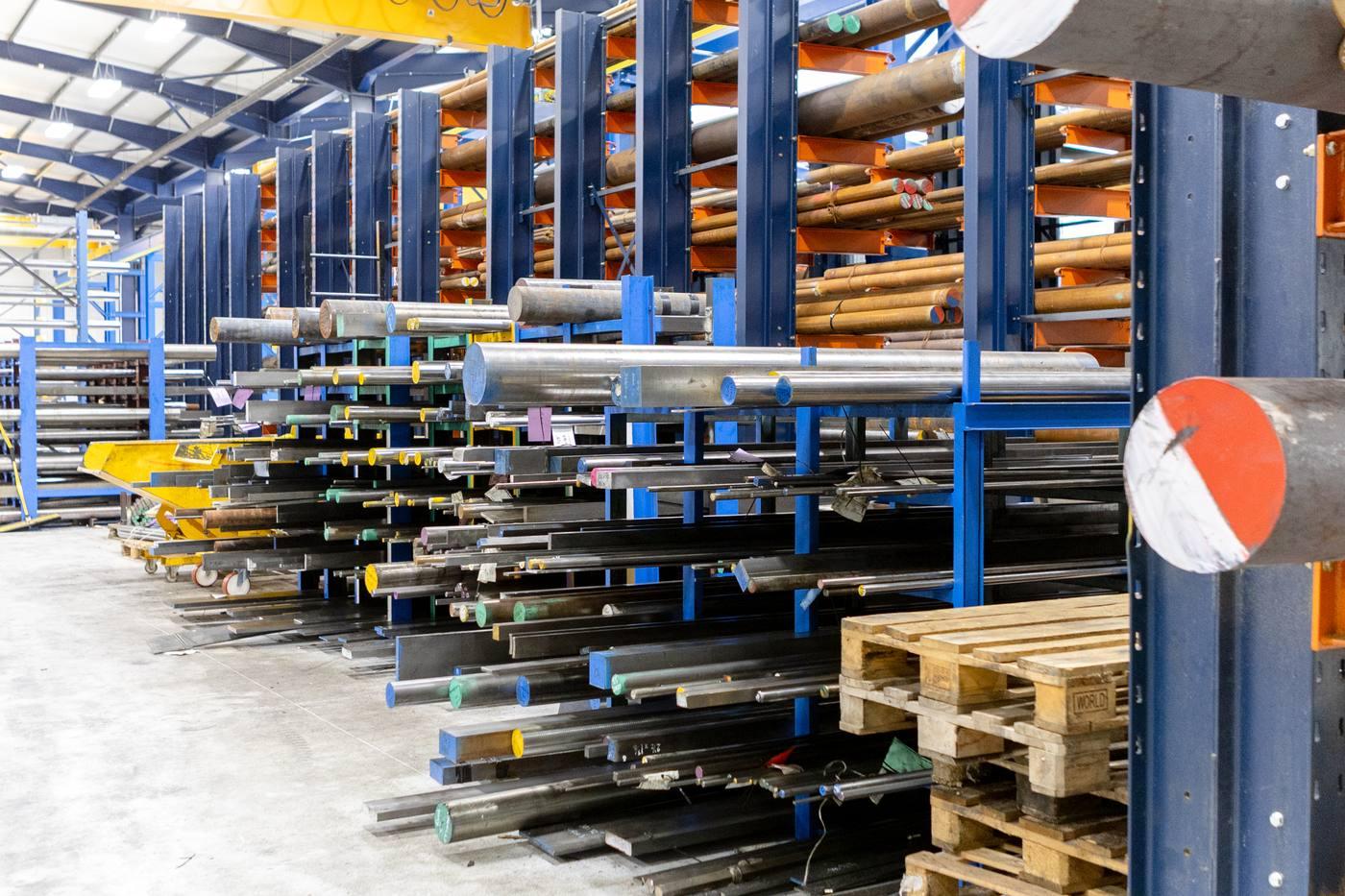
Continuously cast rounds: 25–400mm diameter. Cut lengths available from stock.
Supply condition: Continuously cast and supplied as-cast, turned or centreless ground. Predominantly pearlitic matrix for higher strength and wear resistance.
Cut to length from 1 piece — −0/+2mm standard tolerance — 2–3 day turnaround — Cutting service details ›
Chemical Analysis.
Typical values shown as percentages by weight (% wt). Values are ranges unless stated as maxima.
| Element | Typical Range (%) | Notes |
|---|---|---|
| Carbon (total) | 3.30–3.80 | Spheroidal graphite nodules |
| Silicon (Si) | 2.00–2.70 | Pearlitic-ferritic matrix |
| Manganese (Mn) | 0.30–0.60 | Promotes pearlite |
| Phosphorus (P) | 0.05 max | |
| Magnesium (Mg) | 0.03–0.06 | Nodularising agent (residual) |
For full chemical analysis with cast number, request an EN 10204 3.1 material test certificate when ordering. Certificate types explained ›
Mechanical Properties.
Indicative values to BS EN 1563. Properties vary by section size and matrix condition.
| Designation | Tensile Strength (N/mm²) | 0.2% Proof Stress (N/mm²) | Elongation A (%) | Hardness (HB) |
|---|---|---|---|---|
| EN-GJS-600C / EN-JS1060 | ≥600 (min) | ≥370 | ≥3 | 190–270 |
Hardness values: see our hardness conversion table to convert between HRC, HB, HV and tensile strength.
Typical Applications.
- Heavy-duty gears and pinions
- Crankshafts and drive components
- Wear-resistant rollers and guides
- High-pressure hydraulic bodies
- Dies, bushes and wear plates
- Loaded shafts and spindles
Key Benefits.
- Highest tensile strength of the stocked ductile grades
- Good wear resistance from pearlitic matrix
- Retains ductile-iron toughness over grey iron
- Surface-hardenable by flame or induction
- Strong, damping alternative to forged steel
Remarks & Guidance.
EN-GJS-600C has a predominantly pearlitic matrix, giving higher tensile strength and hardness with lower elongation than the ferritic grades. Best suited to heavily loaded, wear-resistant components where strength is prioritised over maximum ductility. Bearing and gear surfaces can be flame or induction hardened. Weldable only with care, using nickel electrodes and pre-heat. Properties vary with section size.