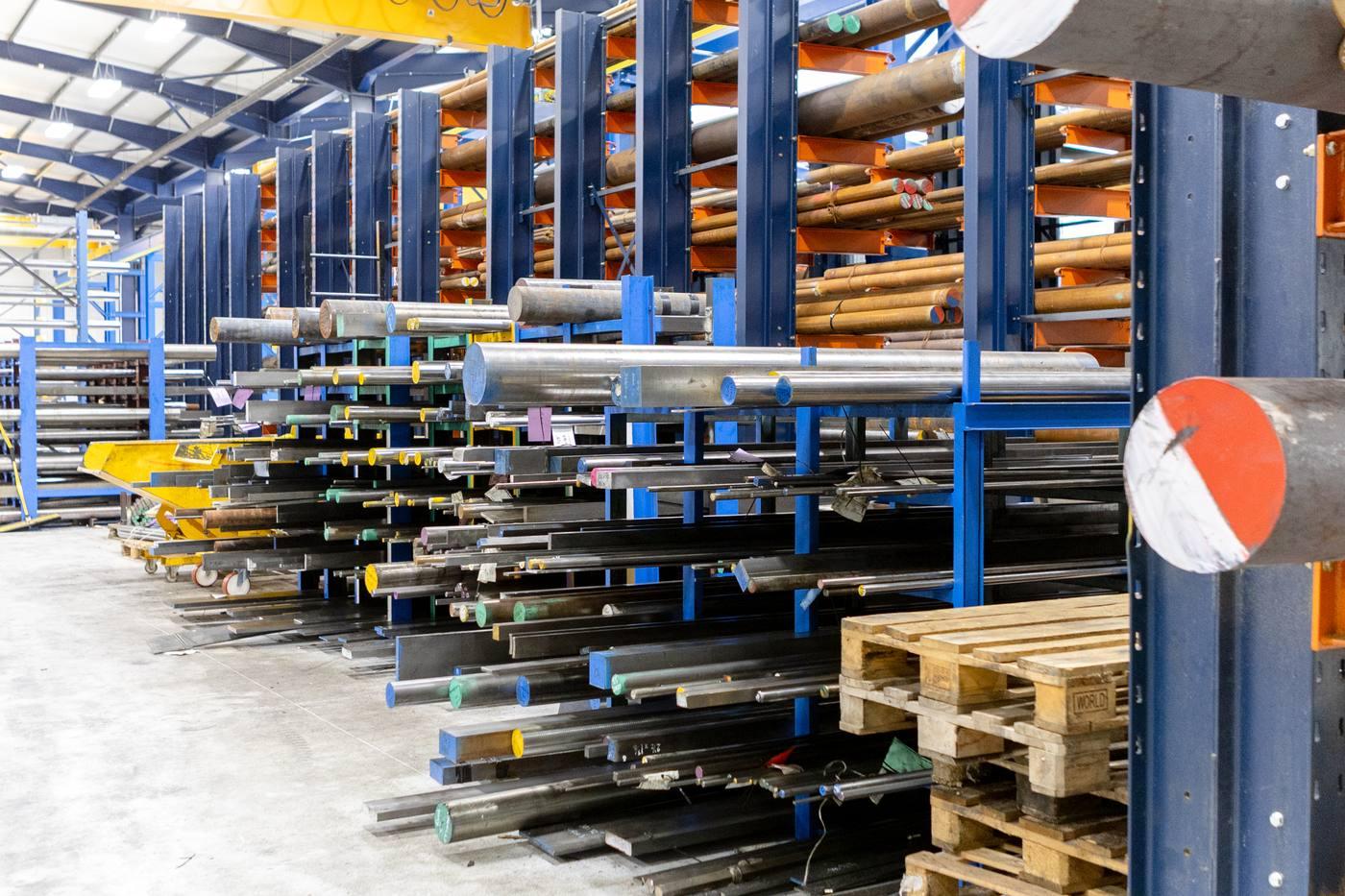
Bright bar and black bar are the same steel grade in two different conditions. The difference is in how they are produced, their surface finish, dimensional tolerance and the applications each is suited to. Understanding the distinction avoids wasted turning time and unnecessary cost.
| Property | Bright Bar (Cold Drawn) | Black Bar (Hot Rolled) |
|---|---|---|
| Production process | Cold drawn through a die after hot rolling | Hot rolled at ~1100°C, air cooled |
| Surface finish | Smooth, clean, bright metallic | Dark mill scale, rough |
| Dimensional tolerance | h9/h10/h11 per BS EN 10278 | ±0.5–2% per BS EN 10060 |
| Typical diameter range | 3mm – 150mm | 16mm – 600mm |
| Preliminary turning required | Often not — goes direct to machine | Usually yes — rough to size first |
| Strength vs hot rolled | Slightly higher — work hardened by drawing | Base mechanical properties |
| Straightness | Better — drawing straightens the bar | May require straightening for long lengths |
| Cost per tonne | Higher (additional processing) | Lower |
| Cost per component | Lower — less machining time required | Higher — more turning to clean up |
| Dimensional standard | BS EN 10278 | BS EN 10060 |
| Best for | CNC turning, automatic lathes, direct to machine | Large billets, structural, large diameter |
| Profiles available | Round, hex, square, flat | Round (primary) |
Bright bar starts life as hot-rolled bar. It is then cleaned of mill scale and cold drawn through a precision die at room temperature. The die compresses the steel slightly, work-hardening it, producing a smooth surface and highly controlled diameter. The drawing also improves straightness. The end result goes directly onto a CNC lathe or automatic turning centre — the collet or chuck grips the bar at the nominal diameter with confidence.
Black bar is rolled at approximately 1100°C and allowed to cool with the dark iron oxide (mill scale) surface intact. The hot rolling process produces the cross-section shape but with less dimensional precision than cold drawing. Tolerances are typically ±0.5–2% of diameter — meaning a nominal 100mm black bar can be anywhere from 99mm to 101mm. Before precision machining, the bar must usually be turned to remove the scale and bring the diameter under control.
The economic trade-off: bright bar costs more per tonne but saves machining time. For diameters below approximately 100–150mm on components going directly to a lathe, bright bar almost always works out cheaper in total cost. Above 150mm, cold drawing becomes impractical and black bar is the only option.
Bright and black round bar in 25 grades. Cut to any length. 3.1 certs available. No minimum order.